Ephebus of Antequera: Where a bronze youth tells the city’s story
In the Museo de la Ciudad de Antequera, in the Palacio de Nájera, stands a bronze statue roughly two thousand years older than everything around it. The Ephebus of Antequera is a life-size bronze statue of a young man from the 1st century AD — and the most important single artefact that the city’s Roman era has left behind.
It was found by chance in 1955 on the Las Piletas estate on the edge of the city. What at first looked like a bent piece of metal in the ground turned out to be one of the most significant Roman bronze statues ever unearthed on the Iberian Peninsula. Today it stands restored in the Museo de la Ciudad, where it is the undisputed centrepiece.
Anyone looking at the Ephebus sees not just a statue of a youth — they see a lost piece of Antikaria, as the Romans called their city.
The statue: a bronze youth from the 1st century
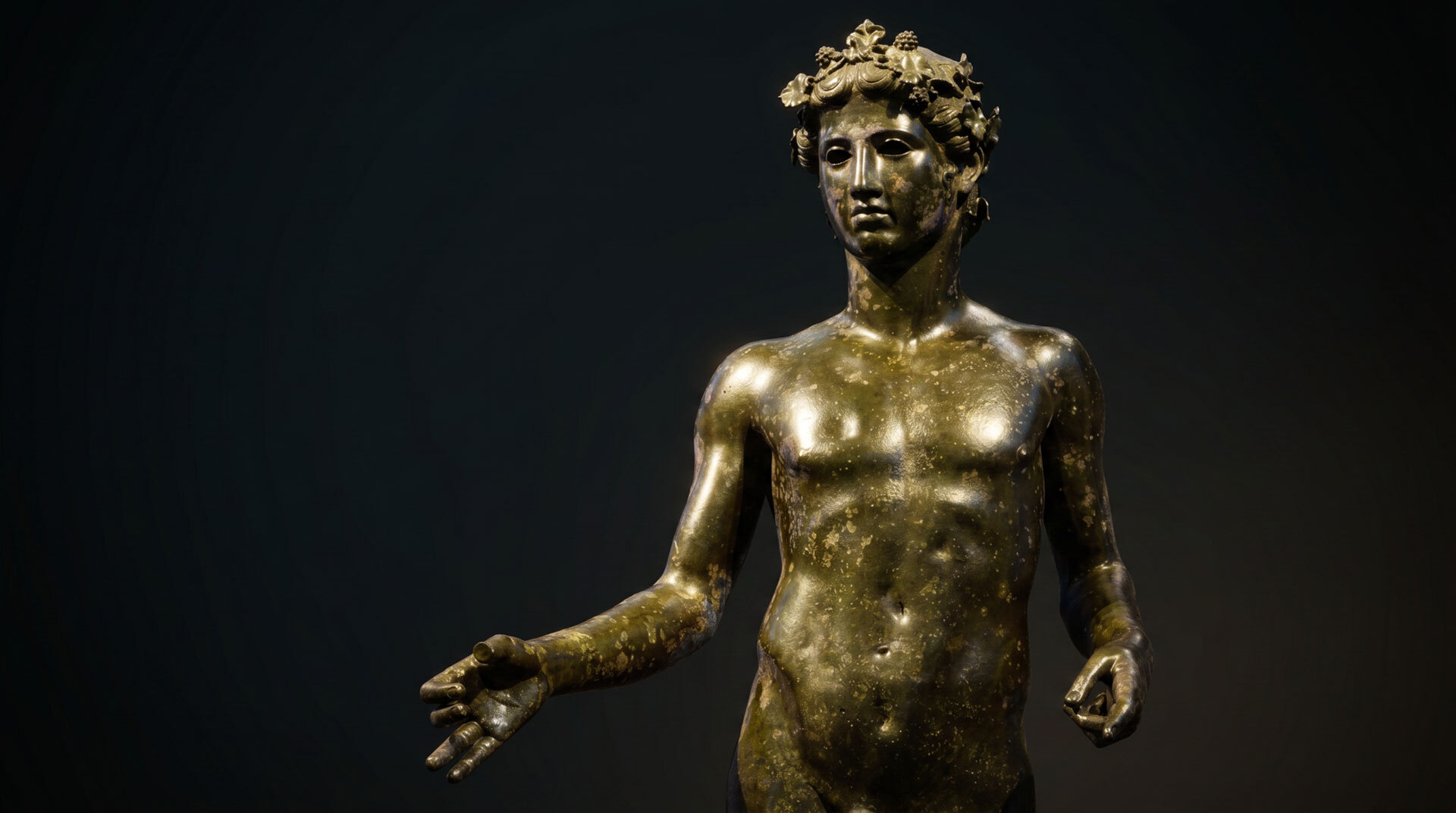
The Ephebus is a fully three-dimensional, life-size bronze figure — about 1.40 metres tall, hollow-cast, in the manner of large Roman bronzes. That the statue still exists today is a stroke of double luck: first, because Roman bronzes were mostly melted down to make weapons or tools from the material. And second, because this Ephebus was apparently buried, whether deliberately or not — and so lay under the earth for centuries, where no one thought to use it as raw material.
What you see — dimensions, material, pose
The statue shows a young man of around 16 to 18 years old — an “ephebus” in the Greek-Roman sense, meaning a youth on the threshold of adulthood. The figure is naked, resting lightly on one hip, with the head tilted to the left. It’s a pose familiar to anyone who has ever seen an ancient statue: the classic standing posture with a weight-bearing leg and a relaxed leg, known in antiquity as contrapposto.
The empty eye sockets are striking. They are not a manufacturing flaw but the result of ancient production technique: the sockets originally held inserts of coloured material — usually glass, stone or bone — which gave the statue a lively, almost alert gaze. Such inlays were standard in the production of large Roman bronzes, but have been lost from almost all surviving bronzes over the centuries. Anyone looking at the Ephebus today therefore looks into two dark, expressive hollows — the original was meant to look quite different. The hair is carefully modelled into individual strands, and the body’s proportions are based on Greek models.
Dating and style
Stylistically, archaeologists place the Ephebus in the early Roman imperial period — probably the first half of the 1st century AD. The pose and proportions follow a classic Greek model from the 4th century BC, the school of Polykleitos. Polykleitos was a Greek sculptor who formulated a binding canon of ideal bodily proportions — his statues were copied and varied by Roman sculptors for centuries afterwards.
The Ephebus of Antequera is therefore not an original 1st-century creation, but a Roman variation on a much older Greek theme. This is not unusual: large parts of Roman statuary consist of such adaptations. What makes the Ephebus special is the quality of its execution and the fact that it has survived in bronze.
The 1955 discovery at Las Piletas
In the summer of 1955, a farm labourer on the Las Piletas estate, an olive grove south of Antequera, struck something hard in the ground while ploughing. What at first looked like an old tool was the head of the bronze statue. The rest followed during careful recovery — the figure had broken into several pieces but was largely intact.
The circumstances of the find remain partly unclear to this day. The statue probably belonged to the furnishings of a Roman villa rustica, a country estate of the kind that must have been common in the fertile countryside around Antequera. Why it was buried there — whether as a deliberate act to protect it from looting, or because the villa was at some point destroyed and the Ephebus buried in the process — can no longer be established from the context of the find. Without this chance discovery in the olive grove, we would not have the piece today.
Antikaria — Roman Antequera
To understand the Ephebus, you need to understand the city in which it stood. In the 1st century AD, Antequera was called “Antikaria” and belonged to the Roman province of Hispania Baetica — the economically richest province of the empire west of Italy. Baths, mosaics and villa complexes from this period are still archaeologically documented across the city today.
A city at the crossroads of the province of Baetica
What made Antequera attractive in Roman times is the same thing that makes it the logistical centre of Andalusia today: its location. The city sits at the intersection of the routes between Hispalis (Seville), Corduba (Córdoba), Iliberris (Granada) and Malaca (Málaga). The plains around the river Singilis (now the Guadalhorce) supplied grain, olive oil and wine. Antikaria was not a large city like Corduba, but it was a prosperous place.
Baths, mosaics, villa complexes
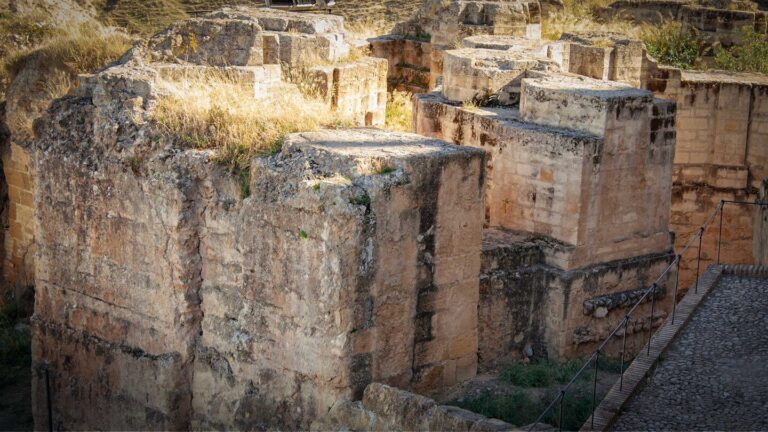
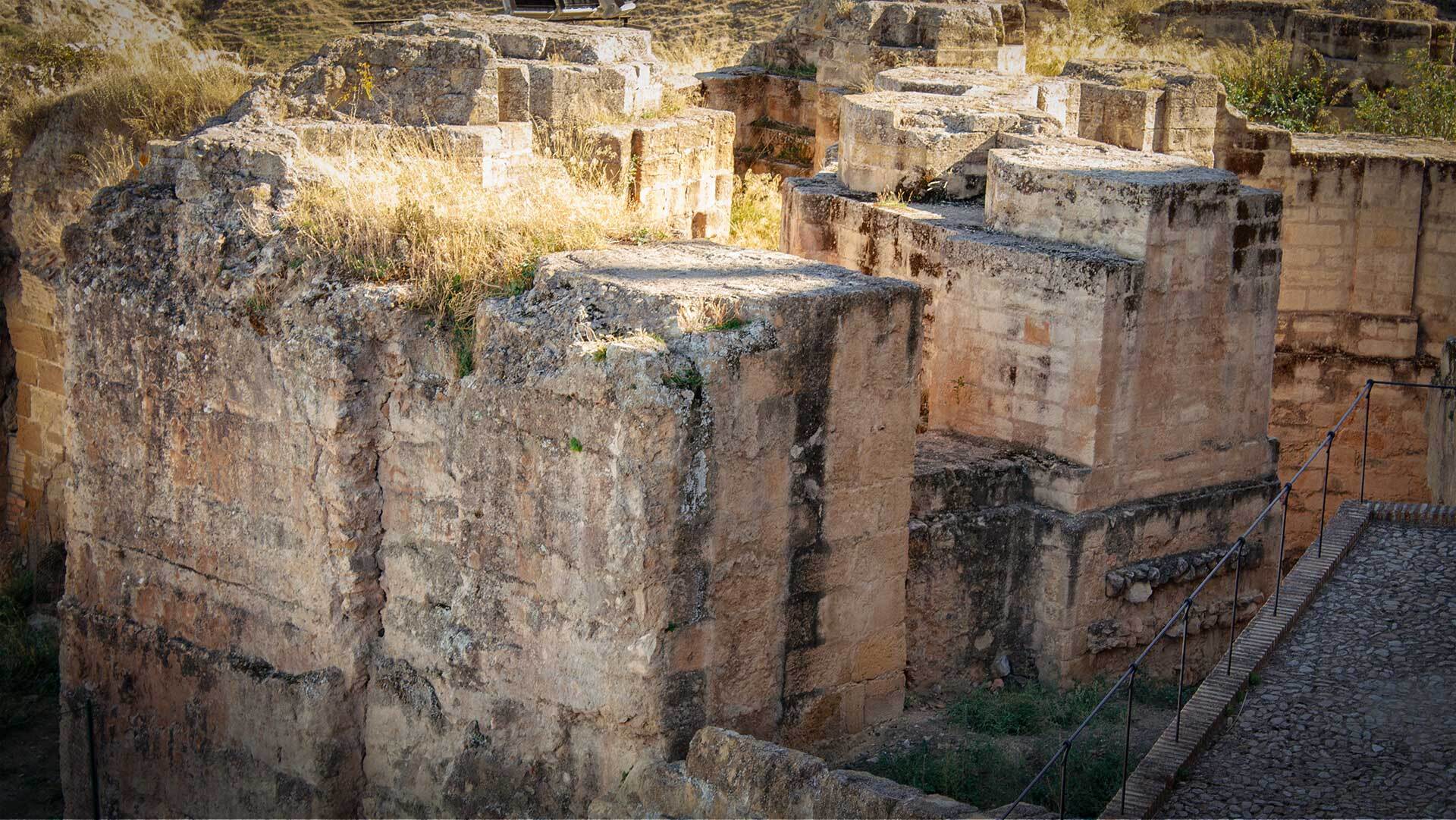
The city’s Roman heritage is still visible today in several places — most famously in the Termas Romanas right next to the Real Colegiata Santa María la Mayor. The bath complex displays the typical Roman components: frigidarium, tepidarium, caldarium. Various villa complexes are also documented across the city, some of them with well-preserved floor mosaics. In the Museo de la Ciudad, these mosaics can be seen alongside the Ephebus — the bronze youth belongs, in a sense, to the same cultural world as the geometric patterns on the villa floors.
From Roman outpost to Moorish town
In the 5th century, the Western Roman Empire fell into crisis, and Antikaria with it. The city remained inhabited — but the high cultural level of the early imperial period was gone. By the time the Moorish conquest arrived in the 8th century, Roman Antikaria was long a thing of the past; “Antikaria” became “Antaqīra” in Arabic. Meanwhile, the Ephebus had lain underground at Las Piletas for centuries — and would remain there until 1955.
In the Museo de la Ciudad de Antequera
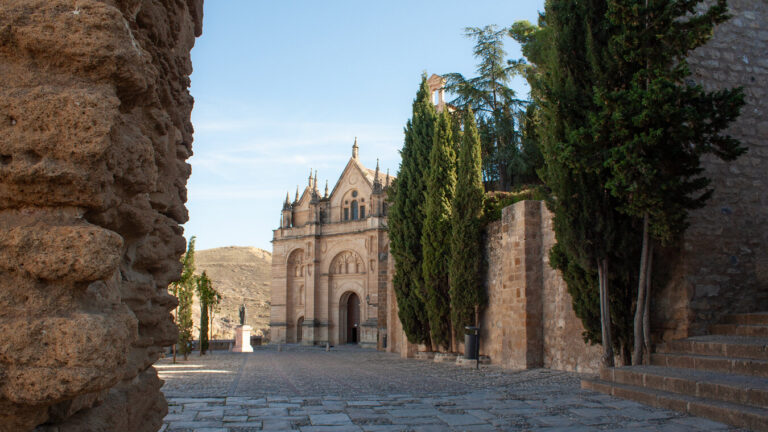
Today the bronze statue stands in the Museo de la Ciudad de Antequera, housed in the Palacio de Nájera — a Baroque palace from the 18th century in the city centre. The museum is considered one of the more important archaeological city museums in Andalusia — not because of its size, but because of the quality of its individual pieces. And the most outstanding piece is the Ephebus.
The Ephebus is accessible from all sides — an important detail, since the pose and modelling only feel complete once you walk around the figure. Anyone who takes their time will notice details that remain hidden at first glance: the fine modelling of the curly hair, the anatomically precise rendering of the shoulders, and the traces of the hollow bronze casting still visible in places.
What else there is to see
The museum shows more than just the Ephebus. Across two floors, regional finds from several eras are on display — from prehistoric tools to Iberian pottery, Roman mosaics and mediaeval pieces. Anyone already at the museum should take time for the mosaics — they round out the picture of Roman Antikaria, the city in which the Ephebus once stood.
| Opening hours & admission — as of May 2026 | |
|---|---|
| Note | Current opening hours and admission prices are available on the official museum website, museoantequera.es. Please check before your visit, as opening days vary seasonally. |
| Address | Palacio de Nájera, Plaza del Coso Viejo, Antequera — within walking distance of the city centre. |
| Visit duration | One to one and a half hours is enough for an attentive visit; mosaic and pottery enthusiasts may want to allow more time. |
Tips for your visit
Combine with the Alcazaba
It’s a ten- to fifteen-minute walk from the Museo de la Ciudad to the Alcazaba and the Colegiata. Half a day is enough for Antequera’s main sights.
Take your time with the Ephebus
The statue is accessible from all sides — only by walking around it do you see how much detail the modelling holds. Allow at least ten minutes.
Don’t overlook the mosaics
The Roman floor mosaics on the upper floor round out the picture of Roman Antikaria. They are less spectacular than the Ephebus, but just as important culturally and historically.
Make use of the summer heat
With temperatures of 40°C in July and August, an air-conditioned museum makes an ideal midday break between a morning and an evening stroll.
Add the Termas Romanas
Anyone wanting to fully understand Roman Antequera should combine the museum with a visit to the Termas Romanas next to the Colegiata — the bath system that belongs to the world of the Ephebus.
Conclusion – a city distilled into a single figure
The Ephebus of Antequera is more than a beautiful bronze. It is the only original survival we have from Roman Antikaria — a life-size figure that has endured two millennia underground and now gazes back at us from empty eye sockets. Anyone looking at the statue in the Museo de la Ciudad sees a city that was once significant far beyond Andalusia.
More on the Roman bath system right next to the Colegiata: Termas Romanas in Antequera. On the Moorish successor on the same hill: Alcazaba of Antequera. On the region’s pre-Roman roots: Dolmen de Menga. More on Antequera in the magazine.
Frequently asked questions
What is an "ephebus"?
Where was the statue found?
Exactly how old is the Ephebus?
Can the statue be visited today?
What other Roman finds are there in Antequera?
This article is based on on-the-ground knowledge from the Gequo editorial team – publishers of several Reisezeit hiking guides and operators of Sunhikes.com. As of: May 2026.