Tholos de El Romeral in Antequera: a domed tomb that points to the karst mountains
Anyone who has seen the Dolmen of Menga and the Dolmen of Viera on the eastern edge of Antequera might think they have grasped the essentials: megalithic tombs are long passages of upright giant stones with flat capstones on top. Then you walk two kilometres further east – and stand before a structure that does everything differently.
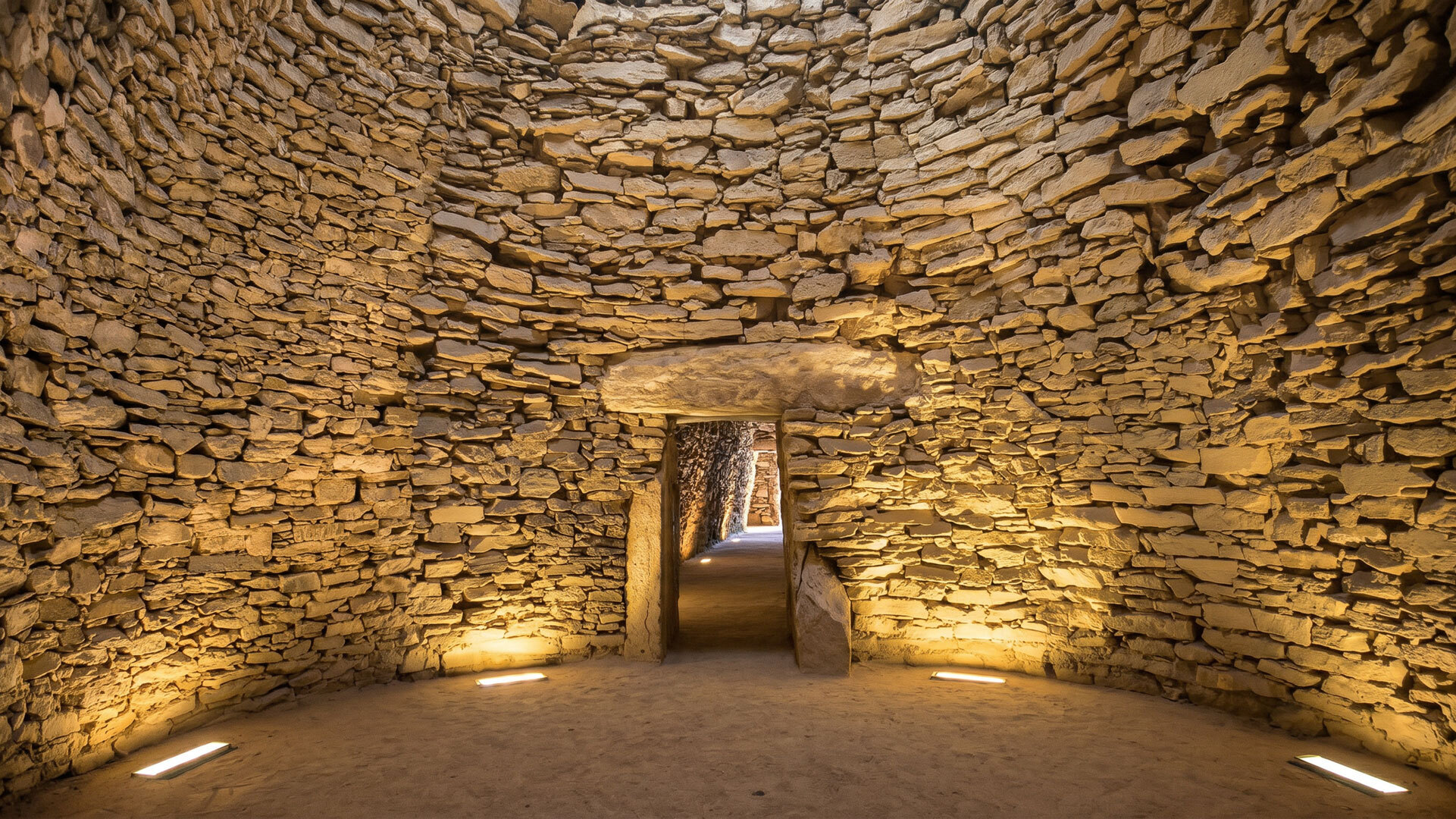
The Tholos de El Romeral is around 500 years younger than its famous neighbours, built around 2,500 BC, at the transition from the Neolithic to the Copper Age. Instead of the orthostat technique with its multi-tonne slabs, it uses a completely different method: smaller stones, laid without mortar, stacked into a corbelled dome. The result is a beehive tomb – rounded and pointed inside, a form also found in the Aegean world at the same time.
And its orientation doesn’t fit any pattern: 199 degrees south-west. While Menga is aligned towards the Peña de los Enamorados and Viera points classically eastwards, Romeral looks across to the El Torcal massif. More precisely: towards the Camorro de las Siete Mesas, a striking point on the karst plateau. This makes the tholos perhaps the quietest but most refined part of Antequera’s UNESCO World Heritage site.
Fact file – the key facts at a glance
Construction period, dimensions, location
The Tholos de El Romeral is the third and youngest of the three great Antequera tomb structures. Anyone comparing the sites will find the finest stonework here – and the most striking play of light inside.
| Bauzeit | um 2.500 v. Chr. (kupferzeitlich, ca. 500 Jahre jünger als Menga und Viera) |
| Bauweise | Tholos / Bienenkorbgrab – falsche Kuppel aus geschichteten kleineren Steinen, ohne Mörtel |
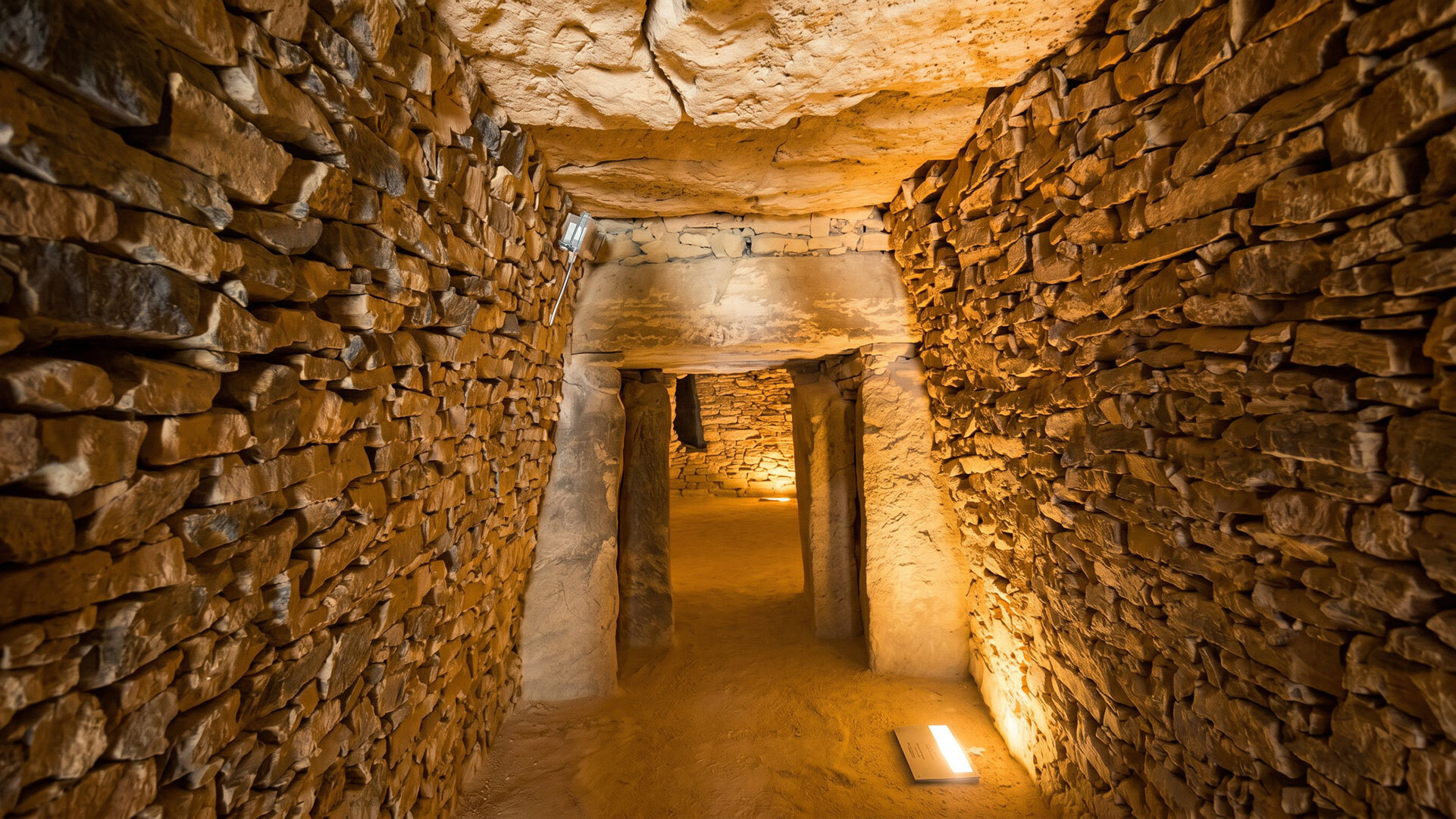
| Länge des Gangs | ca. 26 m |
| Hauptkammer | kuppelförmig, mit 20 cm dicker Kalksteinplatte im Inneren (Funktion unbekannt) |
| Nebenkammer | kleinere zweite Kammer, mit 10° versetzter Öffnung |
| Lichteffekt | zur Wintersonnenwende (21. Dezember) fällt Sonnenlicht direkt auf die Rückwand der Nebenkammer |
| Ausrichtung | 199° Südwest – ungewöhnlich für die Iberische Halbinsel; zielt auf Camorro de las Siete Mesas im El Torcal |
| Tumulus | Grabhügel ca. 68 m Durchmesser, von einem Baumkranz gekrönt |
| Lage | rund 2 km östlich des Dolmen-Areals Menga/Viera |
| Status | UNESCO-Welterbe seit 15. Juli 2016 (gemeinsam mit Menga, Viera, El Torcal, Peña de los Enamorados) |
| Öffnungszeiten/Eintritt | ⚠️ vor Besuch auf turismo.antequera.es · museosdeandalucia.es prüfen (Stand: Mai 2026) |
Construction method: what a “false dome” actually is
Beehive tomb instead of orthostat technique
The construction method of the Tholos de El Romeral is technically called a tholos – from the Ancient Greek for “round building”. In German it is often also called a Bienenkorbgrab (beehive tomb), because the finished shape genuinely resembles a giant beehive from the outside. Inside, the tomb has no multi-tonne capstones like Menga, but a dome.
However, this dome is not a true dome in the sense of Roman or Gothic construction. It is a so-called false dome or corbelled vault: row by row, each stone was set slightly further inward until the circle closed at the top. This works because earth and stones are piled up on the outside – they press the individual rows together and hold the structure in shape.
Compared with Menga, Romeral is almost delicate. The stones are small, yet the effect is still monumental, because the builders worked not with mass but with geometry and layering. The farming societies of the region had learned a different technique in the 500 years between Menga and Romeral – or adopted it from travellers, traders or itinerant craftsmen.
Inside the main chamber lies a 20 cm thick limestone slab. Nobody knows to this day what its function was. Altar, grave slab, sacrificial table – there are many guesses, but no definitive explanation.
The orientation: why Romeral points towards El Torcal
199° south-west – and the Camorro de las Siete Mesas
While Menga is aligned north-east towards the Peña de los Enamorados and Viera points classically eastwards, Romeral breaks the mould. Its main axis lies at 199° south-west – an orientation that is hardly ever found elsewhere in the megalithic architecture of the Iberian Peninsula.
The target, however, is just as specific as at Menga: the Camorro de las Siete Mesas, a striking rocky point in the El Torcal de Antequera nature park. This creates a fascinating pattern for the Antequera ensemble: Menga points towards a natural table mountain in the north-east, Romeral points towards a karst backdrop in the south-west. Two tombs, two natural monuments that echo one another – in 2016 UNESCO explicitly recognised this interweaving of construction and landscape as “unique on the World Heritage List”.
Then there is the play of light inside. The smaller side chamber has an opening that is offset by 10 degrees from the main axis. It is precisely this offset that ensures that, at the winter solstice on 21 December, the last daylight falls through the doorway onto the back wall of the side chamber. This is the reverse logic to Menga, where the summer solstice and morning play the leading role: Romeral celebrates the end of the year and the fading of daylight.
Together with Menga and Viera – a three-part World Heritage site
Three sites, three construction types, one archaeological context
The Tholos de El Romeral does not stand alone. It is part of an ensemble that UNESCO protected as a World Heritage Site in 2016 under the title Sitio de los Dólmenes de Antequera – Andalusia’s seventh World Heritage Site. The World Heritage Site comprises three megalithic monuments (Menga, Viera, Romeral) and two natural monuments (Peña de los Enamorados, El Torcal). This combination is genuinely unique on the World Heritage List.
Romeral, however, was built around 500 years later than its neighbours. By this time, the first urban cultures had long since emerged in Anatolia, and on Crete preparations were underway for the Minoan civilisation. Andalusia was no outsider in this Mediterranean world – the tholos technique itself suggests there were connections across great distances.
UNESCO World Heritage Site: Sitio de los Dólmenes de Antequera
Inscribed on 15 July 2016 as Andalusia’s seventh World Heritage Site. The listing comprises three megalithic monuments (Menga, Viera, Tholos de El Romeral) and two natural monuments (Peña de los Enamorados, El Torcal). Menga points towards the Peña, Romeral points towards the El Torcal karst massif – UNESCO recognises this connection between construction and landscape as unique.
Practicalities – when to go, what to combine it with
Time of day, getting there, combining with Menga and Viera
The Tholos de El Romeral lies around two kilometres east of the main Menga/Viera site, set within a landscape of industrial areas and olive groves on the outskirts of Antequera. Travelling by car or taxi is the simplest option – a small dedicated car park sits right at the entrance. Anyone wanting to walk from Menga should allow around 25 to 30 minutes, ideally not in the midday heat.
The best time to visit is the early morning: the sun sits low, the entrance is bathed in warm light, and the contrast with the cool, dim interior of the dome is at its strongest. Anyone wanting to experience the winter solstice should plan to be in Antequera in late December and ask locally – the specific light phenomenon can only be seen on a few days each year, and on some winter days it is explained on site with a guide.
It’s practical to combine all three World Heritage sites in one morning: first Dolmen de Menga and Dolmen de Viera on the same site, then the tholos two kilometres further east. Anyone who then continues the day with an afternoon visit to the El Torcal karst massif – the very mountain Romeral has pointed towards for 4,500 years – will have seen the entire UNESCO ensemble in a single tour.
The centre of Antequera can be reached from the tholos in a ten-minute drive. A lunch break in the old town is easily doable: Plaza de San Sebastián, followed by the Alcazaba or the Real Colegiata Santa María la Mayor.
Tips for visiting the Tholos de El Romeral
The key points at a glance
Practical notes on the Tholos de El Romeral
Best time of day: early morning – warm low-angled light at the entrance, cool half-darkness in the dome
Special day: winter solstice (21 December) – sunlight strikes the back wall of the side chamber
Combination tip: Menga + Viera (shared site), followed by Tholos de El Romeral (2 km east)
Admission: check current details at turismo.antequera.es · museosdeandalucia.es (as of May 2026)
Getting there: small dedicated car park at the entrance, or a 25–30 minute walk from Menga
Onward journey: El Torcal is a 15–20 minute drive south – the karst massif that Romeral points towards
Conclusion: the quietest yet most refined of the three Antequera structures
Anyone who visits all three Antequera megalithic tombs only truly understands, at the Tholos de El Romeral, just how steep the learning curve in 500 years of building could be.
Menga is the raw power of the first generation: 180-tonne stones, moved into position without the wheel or steel. Viera is the classic variant: a straight corridor, aligned exactly with the rising sun. Romeral is the accomplished build: a beehive of stacked stones, set within a 68-metre tumulus, with refined light architecture and a view of the karst massif to the south.
Weiter zum Dolmen de Menga, zum Dolmen de Viera, zur Übersicht des UNESCO-Welterbes von Antequera und zum Karstmassiv Paraje Natural El Torcal de Antequera, auf das der Romeral seit 4.500 Jahren zeigt. Back to the Magazinee overview
Frequently asked questions about the Tholos de El Romeral
How old is the Tholos de El Romeral?
What is the difference between a tholos and a dolmen?
What is the Tholos de El Romeral aligned with?
Where exactly is the Tholos de El Romeral located?
Is the tholos part of the UNESCO World Heritage Site?
This article is based on the on-the-ground knowledge of the Gequo editorial team – publishers of several Reisezeit hiking guides and operators of Sunhikes.com. As of: May 2026