Montpellier maple in El Torcal: where stone casts shade
Astonishingly few trees grow across 17 square kilometres of limestone. Anyone hiking in El Torcal first sees rock, cushion plants and shrubs, then a few oaks — and suddenly, often at a bend in the path, a gnarled tree with three-lobed leaves that seems to grow straight out of a crack in the rock. This is the Montpellier maple in El Torcal: the region’s symbolic tree, listed in the “Red Book of Endangered Wild Plants of Andalusia”, and so defining for the park that a single specimen on the Ruta Verde has its own name – “Arce de la Ruta Verde”.
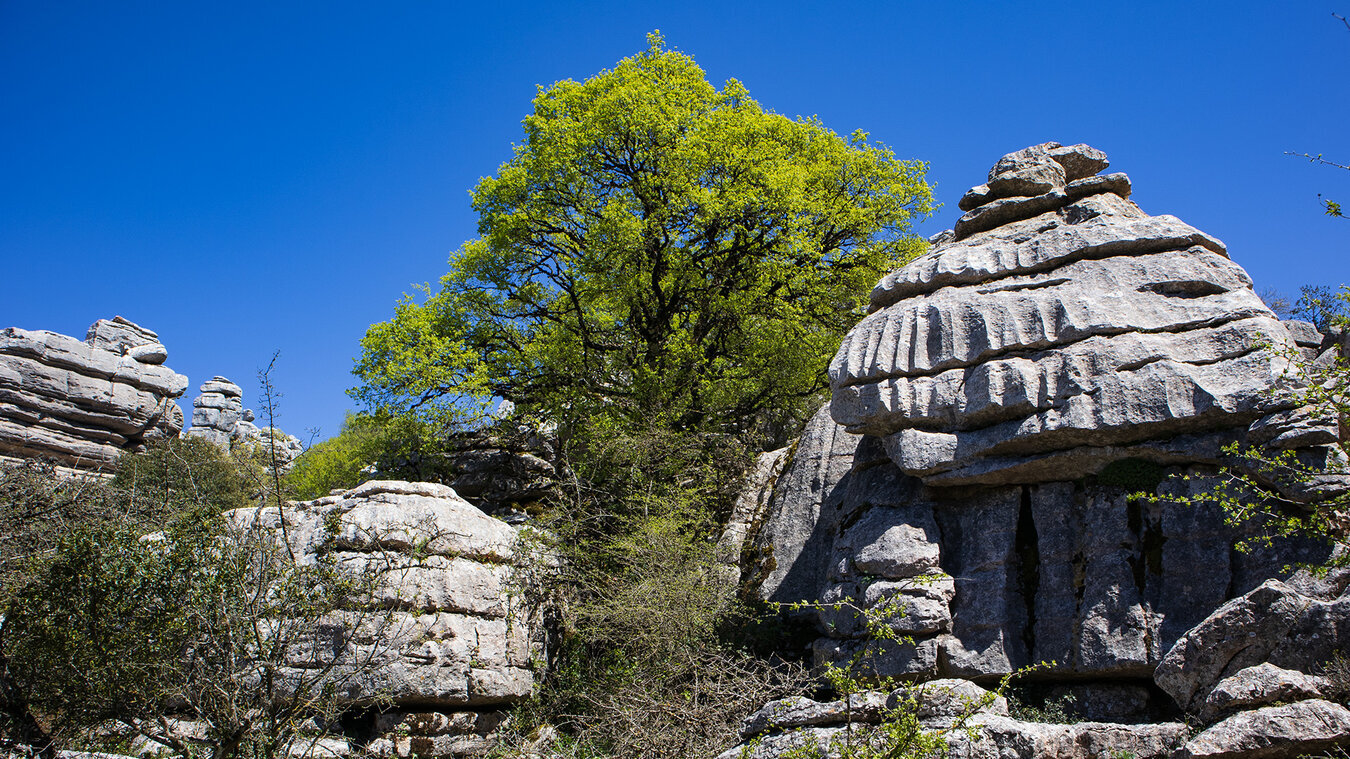
The species’ scientific name is Acer monspessulanum, a true Mediterranean plant from the soapberry family (Sapindaceae). It is a distant relative of the classic Norway maple found in German parks, but has a very close relationship with the karst of El Torcal: few other large trees cope so well with such barren, lime-rich soil.
A tree that can handle karst
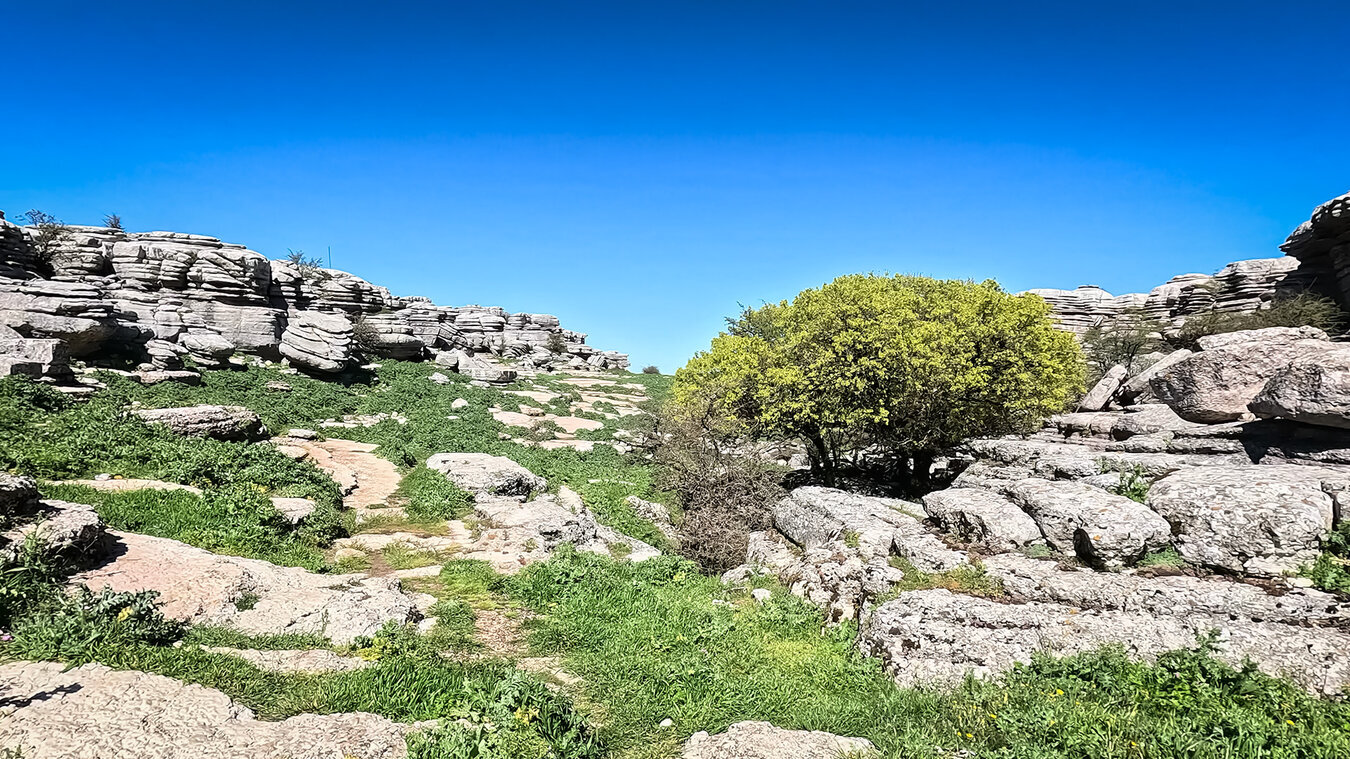
In El Torcal, large trees are the exception, not the rule. The subsoil is limestone, the layer of earth is often thin, and water drains away through cracks in the rock rather than collecting around roots. To survive here, a tree has to reach deep into the fissures, manage with very little substrate and cope with drought. That is exactly what defines the Montpellier maple.
Three large tree species define the park. The holm oak (Quercus ilex) and the Portuguese oak (Quercus faginea) are the sturdy classics — both large, both long-lived, both adapted to Mediterranean drought. The Montpellier maple is the third in this trio, and compared with the oaks it is the more slender tree, often multi-stemmed, which does not form such massive trunks but instead grows in spots where no oak seedling would ever take root.
Roots in rock crevices – the karst strategy
What makes the Montpellier maple a karst specialist is its readiness to manage with almost nothing. Its roots push into the finest cracks in the rock and draw moisture from reservoirs beneath the surface. Inside the karst massif lies one of the largest groundwater reserves in Andalusia — around 15.5 billion litres, released gradually through fissures and joints. Whatever seeps to the surface waters the vegetation that knows how to find these spots.
On top of that, the Montpellier maple tolerates lime well. Many tree species struggle on lime-rich soils — the roots take up iron poorly and the leaves turn yellow (“chlorosis”). Acer monspessulanum is different. It is evolutionarily built for lime-rich sites and thrives where other trees give up after just a few years.
How to recognise the Montpellier maple
Once you know what to look for, you will never overlook this tree again. Three features make it unmistakable: the leaf, the fruit and the growth form.
Three-lobed leaves, small winged fruits
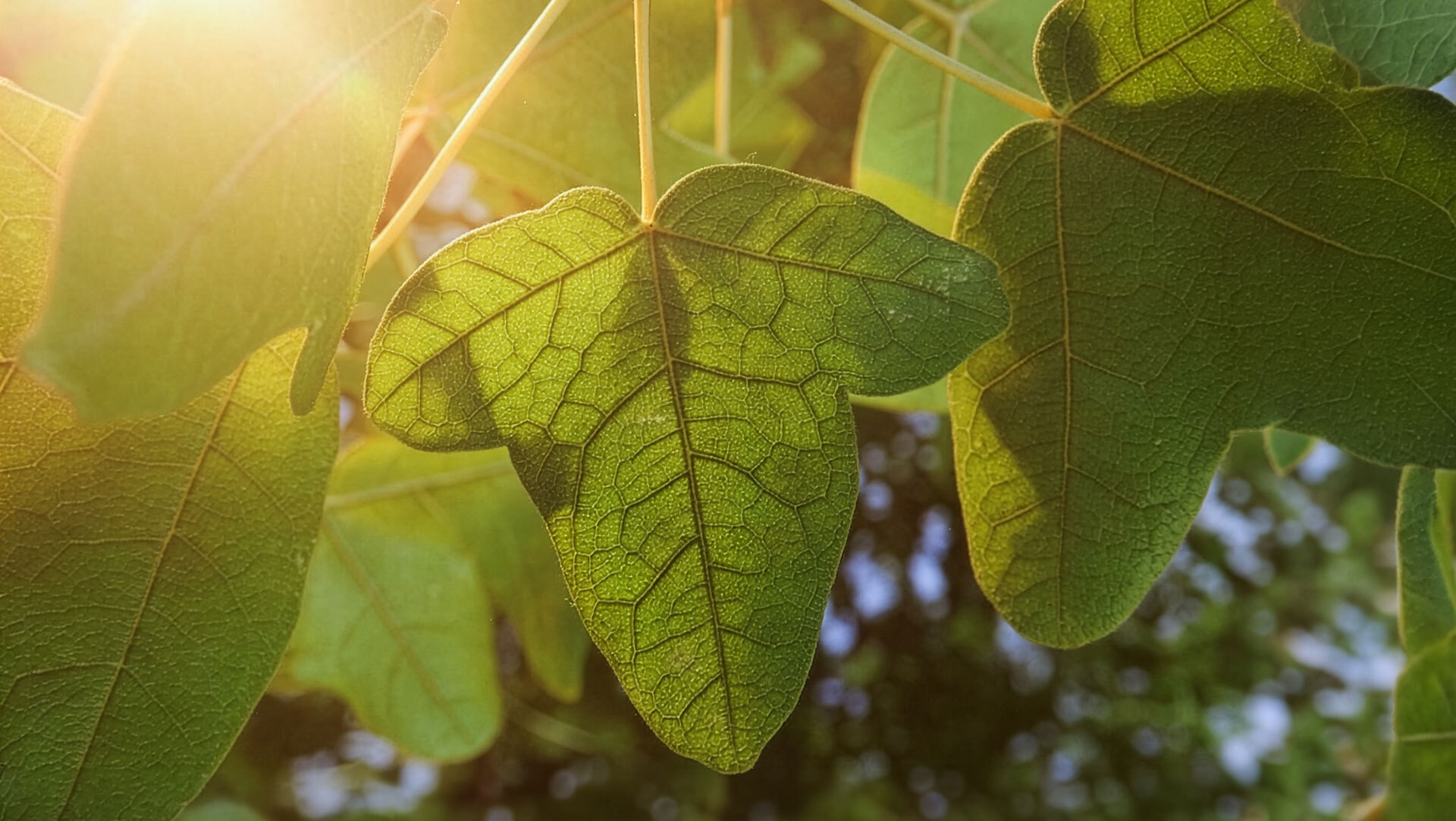
The leaf is the clearest identifying feature. Unlike the central European sycamore maple with its five clearly visible lobes, the Montpellier maple has only three lobes, noticeably smaller and leathery to the touch. Four to six centimetres across, glossy dark green above and slightly paler below, its shape reminds some people of a clover leaf and others of a small hand.
In late summer the fruits ripen – the typical maple winged seeds, paired like little propellers. In the Montpellier maple, the two wings sit almost parallel and pressed together, rather than spread wide as in the sycamore maple. A reliable second identification feature, should the three-lobed leaves not yet have settled the matter.
Growth form between shrub and small tree
In central Europe the Montpellier maple is classed as a “small tree”: typically five to ten metres, rarely taller. In El Torcal, most specimens stand as broad, sprawling shrub-trees among the rocks, often multi-stemmed from ground level, with a crown wider than it is tall. This growth form is a response to wind, grazing by sheep and the limited room available for the roots. A tall, straight trunk would be wasted effort here.
The bark is grey-brown, deeply furrowed and longitudinally cracked in older trees. Young shoots are smooth. Very old specimens often show a characteristic structure: individual thick main trunks with rugged bark, interspersed with younger wood formed after injuries or weathering.
The “Arce de la Ruta Verde” – a natural monument beside the path
In El Torcal, a single specimen of this species has its own name: the “Arce de la Ruta Verde”, the maple of the Green Route. Anyone walking the shortest of the three hiking routes — 1.8 kilometres from the visitor centre — passes directly by it. It is under nature protection and designated as an individual natural monument.
Exactly where it stands
The tree grows on the central section of the Ruta Verde, in the area between the rock formations known as the Sphinx (La Esfinge), the Eagle, the Indian and the Guard. It cannot be missed from the winding path: a gnarled, broadly spreading specimen that appears to grow straight out of the karst rock, with a clearly visible nature-protection notice. In spring and summer it carries full foliage, in autumn it glows yellow-orange, and in winter it displays its characteristic tangle of branches.
Why it is protected
Three reasons account for its protected status. First, the species itself is endangered — listed in the “Red Book of Endangered Wild Plants of Andalusia”. Second, this specimen is especially old and large — such individuals are rare and ecologically valuable in the karst landscape of El Torcal. Third, the tree has a cultural role: as a symbol of the whole region and a landmark on one of the most-walked hiking routes, it receives the attention that many inconspicuous karst plants never get.
In concrete terms, the protection means: nobody may break off branches, carve into the trunk, expose the roots or collect seeds. An information board explains this on site. Even small interventions can permanently weaken the tree at such a barren location.
When the tree is at its most striking
The Montpellier maple shows four very different faces over the course of the year. Anyone visiting the park more than once, or coming specifically to see this tree, should plan around the season.
Spring: delicate leaves, small flower clusters
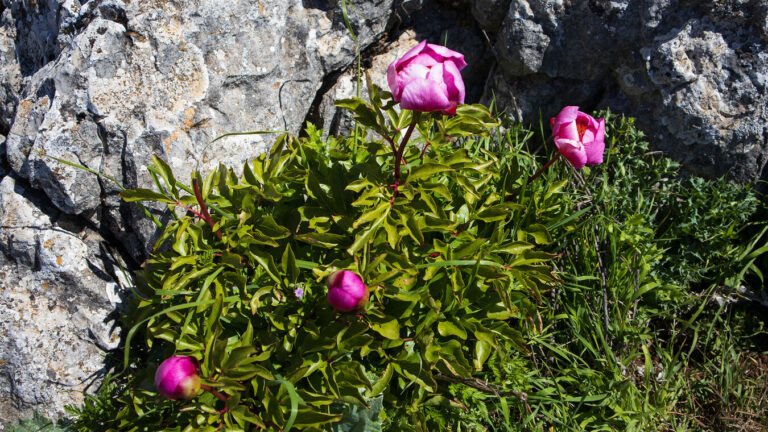
The tree comes into leaf in April and May. The young leaves are light green, almost yellowish, and look fresh before developing into a firm mid-green over the summer months. At the same time, small, unassuming yellow-green flower clusters appear — no spectacular blossom like that of the peony, but worth noting for attentive botanists. Pollination happens via wind and insects.
Autumn: golden yellow in the karst
Autumn is the tree’s finest moment. In October and November the three-lobed leaves turn a brilliant yellow-orange — a colourful contrast against the grey limestone that briefly gives the karst a different mood. Photographers come to the park specifically for these two weeks. Exact timing varies with the weather, but a visit is worthwhile from mid-October onwards.
Summer and winter: drought and frost
In summer the tree carries full, mid-green foliage. On particularly hot days it curls its leaves slightly to conserve water — a visible response to drought. In winter it loses its leaves completely. Its gnarled tangle of branches is then revealed in full clarity, giving the tree an almost sculptural quality, especially in the early winter months. Frost down to -10°C, which can occur in El Torcal, is no problem at all for a mature tree.
Tips for observing the Montpellier maple in El Torcal
Best season
Mid-October to mid-November for the autumn colours. April and May for the delicate spring leaves and flower clusters. Summer is rewarding for size and growth form, winter for the branch structure.
Location of the natural monument
The “Arce de la Ruta Verde” stands on the central section of the Ruta Verde, between the Sphinx (La Esfinge) and the other rock formations. It is around 15 to 20 minutes’ walk from the visitor centre.
Identification tip
A three-lobed, leathery leaf four to six centimetres across — clearer than any other species in the park. The winged fruits in late summer confirm the identification.
What is not allowed
Do not take branches, leaves or seeds, do not mark the trunk, and do not climb the tree. Protected status applies all year round, even when no warden is present on site.
Photo tip
In autumn, choose morning light — when the sun falls low across the rocks, the yellow-orange foliage stands out especially well against the grey limestone. A polarising filter reduces distracting reflections on the leaves.
Conclusion – the Montpellier maple in El Torcal
The Montpellier maple is not the largest, not the most common, not the most spectacular tree in Andalusia — but it is the one that best suits the karst of El Torcal. Anyone visiting the natural monument “Arce de la Ruta Verde” sees, in a single specimen, everything that defines the karst flora: adaptation to extremely barren sites, slow growth and beauty in the detail.
Anyone wanting to know more about the karst flora will find an overview of all the symbolic species in the article on peonies, hedgehog broom and Antequera catmint. Anyone wanting to see the tree in person should plan a visit to the Ruta Verde — ideally in October, when the leaves glow yellow-orange. For an overview of the nature park, see Karstlandschaft El Torcal, and to find out which season is most worthwhile, see the article on the best time to visit.
Frequently asked questions
Where does the famous "Arce de la Ruta Verde" stand?
How do you recognise the Montpellier maple?
When is the best time to see it?
Why is the tree protected?
How old does a Montpellier maple get?
This article is based on the on-the-ground knowledge of the Gequo editorial team – publishers of several Reisezeit hiking guides and operators of Sunhikes.com. As of: May 2026