Fuente de Piedra: Where Spain’s Largest Flamingo Colony Calls Home
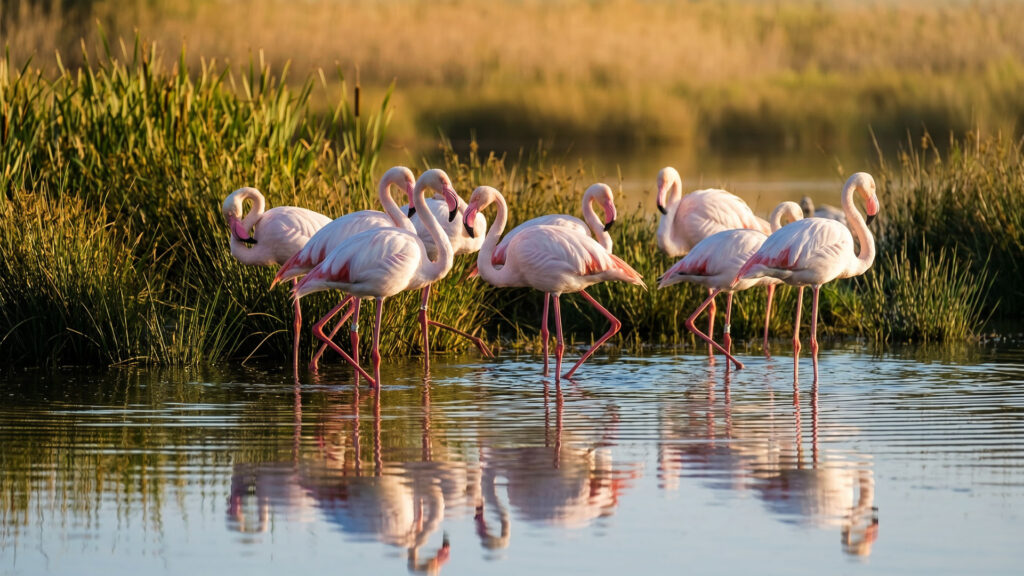
Anyone driving from Antequera towards Seville spots it from the A-92 already: a flat, wide salt lake that gleams silvery or turns completely pink, depending on the water level. At 6.5 kilometres long, the Laguna de Fuente de Piedra is Andalusia’s largest natural lagoon – and, at the same time, Spain’s most important flamingo breeding ground. In good years, up to 50,000 greater flamingos come here to breed, a density otherwise found only in the Camargue or at Tuz Gölü in Turkey.
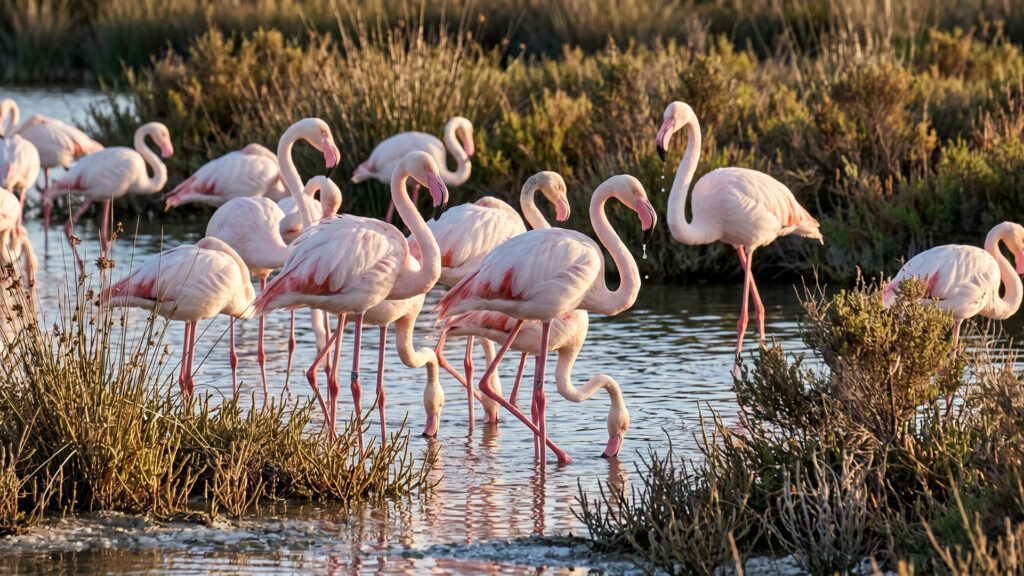
What makes Fuente de Piedra special is its unusual ecosystem. The lake is endorheic – meaning it has no outflow. No stream flows in, no river flows out. Rain is the only source of water, evaporation the only way it leaves. The result is a high salt content, a very shallow layer of water rarely more than a metre deep, and, in the dry summer, a salt crust that gleams white in the sunlight. Brine shrimp live in this salt lake – the pink-tinted food that gives the flamingos their colour.
It is only 25 kilometres from Antequera, and 74 kilometres from Málaga. A half-day trip that offers a completely different experience depending on the season. Visitors who come in spring see tens of thousands of birds. Visitors who come in high summer sometimes find nothing but a salt pan. When a visit is worthwhile, how the visitor centre works, and which other bird species can be seen here – the key answers for the trip.
The flamingo colony: Spain’s largest breeding site, Europe’s second-largest
Why the birds gather here of all places
After the Camargue in southern France, the Laguna de Fuente de Piedra is the second most important breeding colony for greater flamingos in Europe. In favourable years – when the spring water level is high enough – up to 20,000 pairs breed here. In 1998, 15,300 chicks were counted in a single crèche, a European record that still stands today. In dry years, breeding fails to happen at all, and the birds move on to Doñana or the Camargue – the colony is therefore not a given, but directly dependent on the climate.
What surprises many visitors: during the breeding season, the adult flamingos fly out every night. The brine shrimp in the lagoon are enough for breeding, but not for raising the chicks. So the parents commute between Fuente de Piedra and feeding grounds at the mouth of the Guadalquivir or in the Bay of Cádiz – distances of 140 to 200 kilometres, mostly flown at night. Individual birds cover up to 300 kilometres in a single night. These are the longest regular feeding flights documented anywhere in the world for the flamingo family.
| Status | largest greater flamingo breeding colony in Spain · second-largest in Europe |
|---|---|
| Numbers | up to 50,000 birds in good years · up to 20,000 breeding pairs |
| Breeding season | April to July – only in years with sufficient rainfall the previous year |
| Chick crèche | 1998, with 15,300 chicks – a European record |
| Feeding flights | 140–200 km to the Bay of Cádiz / mouth of the Guadalquivir, at night |
| Record flight | up to 300 km in a single night – the longest feeding flight in the family |
The pink colour comes from the birds’ food: brine shrimp and microalgae contain carotenoids that are deposited in the feathers. Chicks are grey, and the characteristic colour only develops after two to three years. In particularly good years, the whole lagoon turns pink in the evening, when the sunlight skims low across the water and the birds stand close together.
Season and water level: When a visit is really worthwhile
From the rainy spring to the dry summer
Fuente de Piedra is a dynamic lake. Unlike a reservoir or a river, it changes shape and size dramatically within just a few months. Anyone planning a visit should know the water level – otherwise you might find yourself in August standing in front of a salt pan without a single bird.
Visiting times by season
| Water level | Bird numbers | |
|---|---|---|
| October–December | water rises with autumn rain | first migratory birds, waterfowl |
| January–March | highest level · lagoon full | thousands of birds · best time to watch |
| April–June | breeding season · flamingos on the islands | peak season · 50,000 birds in good years |
| July–August | lagoon dries out | flamingos move on · lake sometimes completely dry |
| September | first rain, slow refilling | transitional season · still quiet |
The best time for observation is between February and May. In February and March the lake is at its fullest, visibility is clear, and the sun is not yet so harsh. In April and May the flamingos start breeding – anyone wanting to see the characteristic flights between the breeding colony and the feeding grounds is best coming early morning or evening. During the day, most birds stand quietly in the water and appear as a pink line from a distance.
Anyone coming in high summer should keep expectations low. In July and August large parts of the lake can be dry, and the flamingos are then mostly in the Camargue or the Guadalquivir Delta. What remains is the salt landscape itself – an impressive geological phenomenon, but less spectacular than expected without the birds.
Practicalities: Getting there, the visitor centre, and walking trails
From the Centro de Visitantes around the lagoon
Getting there from Antequera is simple. Take the A-92 west, past Humilladero, exit at Fuente de Piedra, then take the MA-6408 into the village and the A-7279 to the visitor centre. That’s 25 kilometres, a good 25 minutes’ drive. Travelling from Málaga, you first head to Antequera and then continue on – 74 kilometres in total, an hour’s drive.
| Getting there from Antequera | A-92 west → Fuente de Piedra exit → MA-6408 → A-7279 · 25 km / 25 min |
|---|---|
| Getting there from Málaga | A-45 → A-92 west · 74 km / 1 h |
| Admission | free – both the visitor centre and the walking trails around the lagoon |
| Car park | free car park right at the visitor centre |
| Observation point | right at the visitor centre · additional viewpoints around the lake |
| Walking trail | gravel track around the lagoon · on foot or by bike |
| Equipment | binoculars strongly recommended · sun hat · water |
| Best time of day | early morning or late afternoon · soft light and active birds |
The Centro de Visitantes “Reserva Natural Laguna de Fuente de Piedra” is located on the eastern side of the lagoon. It has an exhibition on flamingo biology, the history of salt extraction, and the ecosystem, plus a raised observation point looking out over the water. Check current opening hours before visiting – they change seasonally and are set by the operator (Junta de Andalucía). Contact for enquiries: visitasfuentepiedra.es or by phone on +34 675 64 59 57.
Guided tours are also on offer – in Spanish and English, with prior booking. They go deeper into the protected area than the freely accessible section and are worth considering for birdwatchers with a serious interest. Anyone just dropping by will do just fine with the free option and a pair of binoculars.
Practical tip: Check the water level before you set off
How rewarding the visit is depends directly on the water level. The lagoon can host tens of thousands of flamingos between February and May – or be completely dry in September. To be on the safe side, check the official website visitasfuentepiedra.es before setting off, or call the Antequera tourist information office.
Also important: do not approach the water itself. The protected area is fenced off – for good reason. Observation takes place from the centre and the viewpoints, not from the water.
In short: A half-day trip that depends on knowing the season
Fuente de Piedra is one of the most impressive nature trips from Antequera – provided the season is right. Anyone there between February and May sees a natural spectacle on a scale otherwise only found in the Camargue: thousands of flamingos on a shallow salt lagoon, a pink carpet in the right light. Come in summer and you’ll often see nothing but salt. Come in late autumn and you’ll see the first migratory birds and a lake filling up again. The recommendation: allow half a day, get up early, and bring binoculars. Anyone who spends the morning at Fuente de Piedra can still visit the Lobo Park nature reserve in the afternoon, or head back to Antequera to see the dolmens.
Three very different natural themes in a single day – geology, birdlife, and megalithic sites – are rarely found packed together this densely.
More on the region: Antequera as a base: Antequera Spain. The Torcal nature park with similar karst geology: El Torcal de Antequera. Another wildlife trip in the region: Lobo Park Antequera. Best time to travel to the region: Best Time to Visit El Torcal & Antequera.
Frequently asked questions about Fuente de Piedra
This article is based on the on-the-ground knowledge of the Gequo editorial team – publisher of several Reisezeit hiking guides and operator of Sunhikes.com. As of: May 2026