Reptiles in El Torcal: where lizards soak up the sun
Anyone hiking the Ruta Verde or the yellow route will spot them sooner or later: a brief shadow flitting across a sunlit rock slab, a blue-green streak vanishing between the karst stones. Reptiles are the most common vertebrates you’ll encounter in El Torcal — and the least conspicuous. Unlike birds of prey, they don’t circle overhead, and unlike ibex, they don’t pose on rocks. They’re there, but you have to look for them.
The official figures for the nature park are clear: 11 reptile species and a single amphibian species live here — part of the 116 vertebrate species recorded in total. Of these, six reptiles are documented by name: the ocellated lizard, Iberian wall lizard and large psammodromus as the trio of lizards; the ladder snake and Montpellier snake as non-venomous snakes; and Lataste’s viper as the only venomous species.
Lizards – the most common encounter in the karst
Anyone exploring a Mediterranean karst massif will see lizards. El Torcal is no exception — quite the opposite, in fact. Sunny rock platforms, warm limestone slabs and crevices to hide in make the terrain an ideal lizard habitat. Three species share the stage, each with its own style.
Ocellated lizard – Europe’s largest lizard
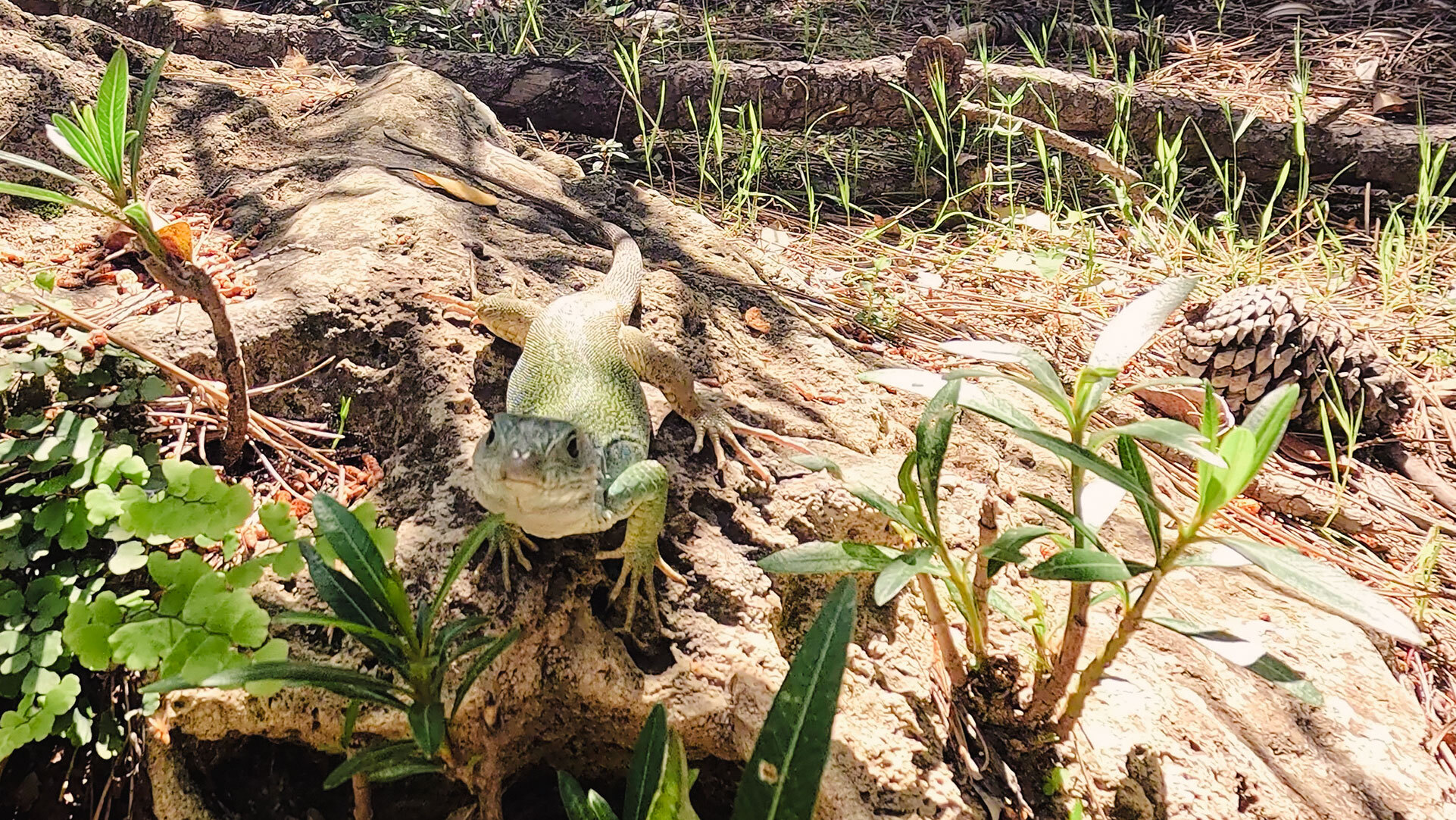
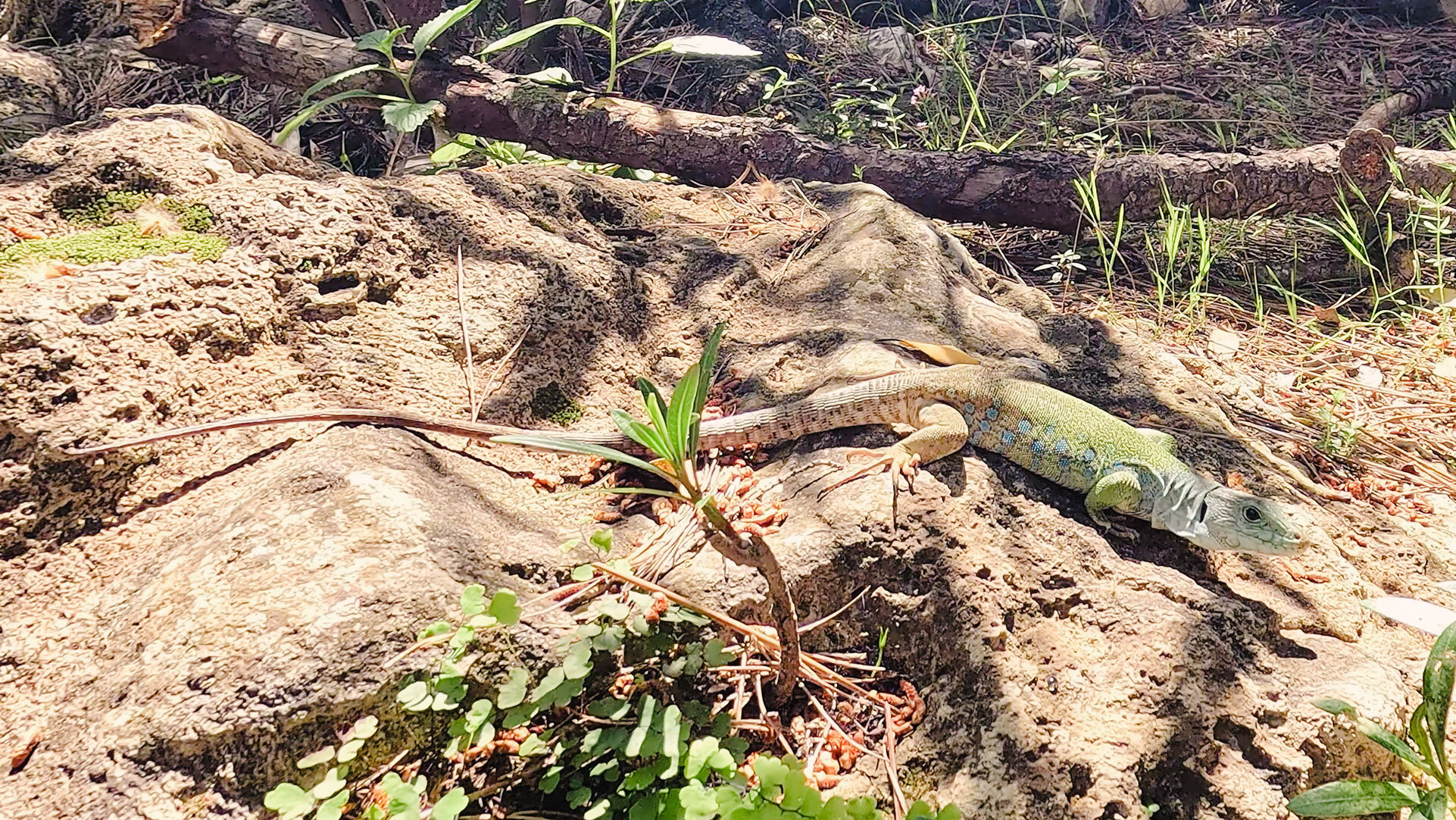
The ocellated lizard (Timon lepidus) is the most spectacular of the three. With a total length of up to 70 centimetres — males occasionally grow larger still — it is one of Europe’s largest lizards. The animal is unmistakable: a greenish-brown base colour dotted with pale eye-spots, often with vivid blue along the flanks. Next to the smaller wall lizard, it looks almost like a dragon.
In El Torcal, the ocellated lizard lives in the open karst areas, favouring spots with loose stones, low vegetation and rock crevices to retreat into. It is active by day, basks on rocks and is shy — anyone approaching usually only sees its lightning-fast retreat. With patience and a pair of binoculars, it can be observed well.
Wall lizard and psammodromus on the rock ledges
More frequently seen is the Iberian wall lizard (Podarcis hispanicus). It is small — usually 10 to 18 centimetres including the tail — slender, agile and perfectly adapted to rocky terrain. On the Ruta Verde and Ruta Amarilla, it constantly darts across path slabs and rock ledges. Anyone who stands still and quiet will often spot several at once.
The large psammodromus (Psammodromus algirus) rounds out the lizard fauna. Slender, with a strikingly long tail and yellowish-brown longitudinal stripes, it moves lightning-fast through the low scrub. Unlike the wall lizard, it prefers denser vegetation and is therefore less often seen on open paths.
Snakes in El Torcal: more myth than menace
Snakes trigger an instinctive unease in some travellers. The reality in El Torcal is more relaxed than the gut feeling suggests: three snake species are documented, two non-venomous, one venomous — and decidedly shy.
Ladder snake and Montpellier snake – the non-venomous species
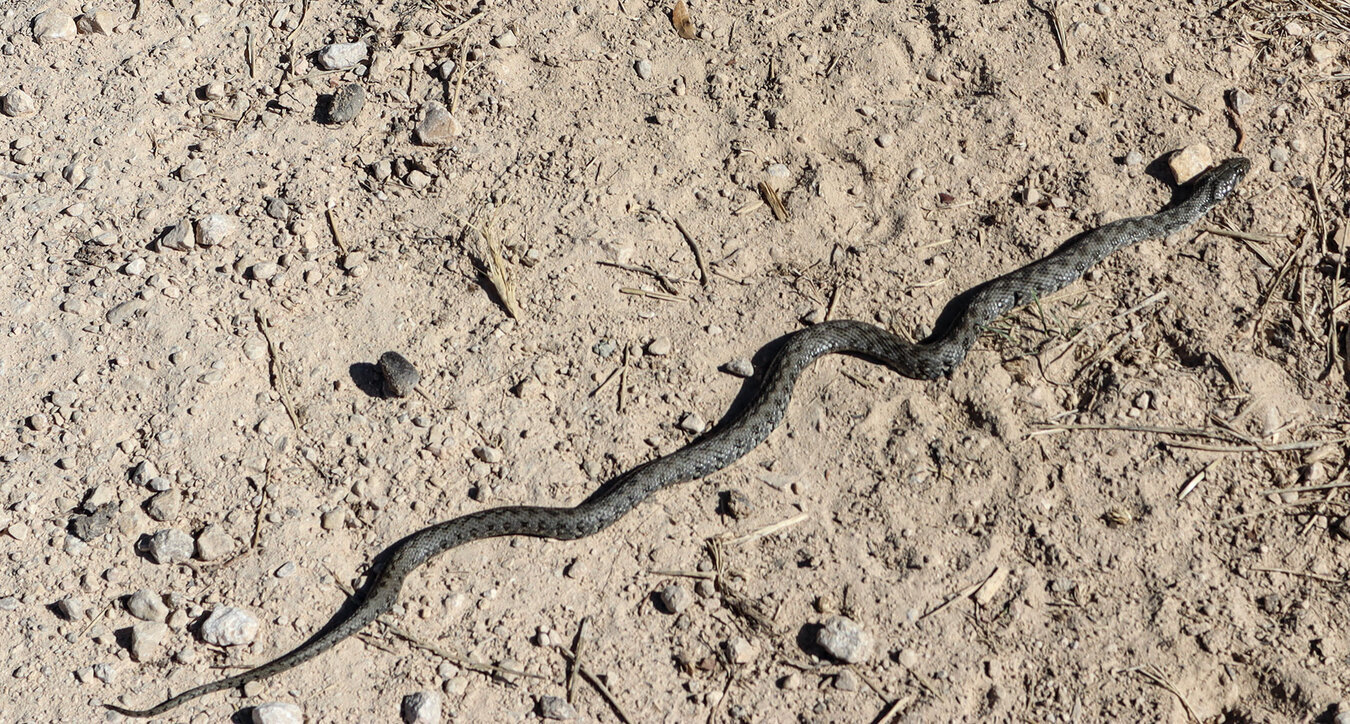
The ladder snake (Zamenis scalaris) is a slender, fast-moving snake that owes its German name to a ladder-shaped pattern on its back. Adults reach lengths of up to 160 centimetres, though 80 to 120 centimetres is more typical. It feeds on lizards, small mammals and birds. It poses no danger to humans.
The Montpellier snake (Malpolon monspessulanus) is the largest snake in the park and can grow to over two metres long. It does have venom fangs at the back of its mouth, but the venom acts on prey animals (lizards, mice) and is considered practically insignificant for humans. Bite incidents are extremely rare, as the snake flees quickly and, when threatened, is more likely to hiss than bite.
Lataste’s viper – the only venomous species in the karst
Lataste’s viper (Vipera latastei) is the only genuinely venomous snake in El Torcal. It has a characteristic upturned snout tip that gives it its name, and a grey-brown pattern with a dark zigzag band along its back — a typical viper appearance. At lengths of between 50 and 75 centimetres, it remains noticeably smaller than the non-venomous snakes.
What makes it relevant to travellers: it does occur in the karst. What puts the worry into perspective: it is extremely shy. Bite incidents in Andalusia are rare and mostly involve people who deliberately handle the animals, or hikers who put their hands into rock crevices without looking. Anyone who stays on the waymarked paths, wears sturdy footwear and doesn’t reach into obscured crevices runs a vanishingly small risk.
The effects of a bite are, in most cases, painful but rarely life-threatening — hospitals in Antequera and Málaga keep antivenom in stock. If bitten, the rule is: stay calm, immobilise the affected body part, and seek medical help immediately or call the emergency number 112. Do not attempt to suck out the venom, do not apply a tourniquet, do not cut the wound open — these are outdated myths that cause more harm than good.
How to encounter reptiles responsibly
Encounters with reptiles in El Torcal are a matter of luck and opportunity. The animals are part of the protected ecosystem, and the park’s ZEPA status extends to all species — not just the birds. That means: don’t disturb them, don’t touch them, don’t catch them.
Stay on the paths, don’t reach into rock crevices
The most important rule follows from both the safety and the conservation concept alike: stay on the waymarked paths. Anyone going off-track actively disturbs reptiles, overlooks hidden animals and increases the risk of an unwanted encounter — especially with Lataste’s viper. Sturdy footwear provides extra protection.
A second rule: don’t put your hands into obscured rock crevices or under large stones. Lizards and snakes use exactly these kinds of hiding places. Anyone wanting to take photos should use a telephoto lens or a smartphone from a respectful distance — not by approaching or chasing the animal.
What applies during a rare snake encounter
The most common snake encounter is with a ladder snake or Montpellier snake, which quickly clears the path — no problem at all. With Lataste’s viper, the response is identical: keep your distance and give the snake time to withdraw. Snakes do not attack proactively; they only defend themselves when they feel threatened or are accidentally touched.
Anyone travelling with children should brief them beforehand on how to behave: don’t run towards animals, don’t try to touch them, don’t poke them with sticks. Dogs should be kept on a lead — not only because of the bird-protection rules within the ZEPA, but also because of Lataste’s viper, whose bite is more dangerous for dogs than for humans.
| Behaviour during reptile encounters | |
|---|---|
| Lizards | Stand still quietly, observe, take photos. The animals are fast, shy and harmless. Anyone approaching usually only sees them retreat into the nearest crevice. Watching works much better with binoculars or a telephoto lens. |
| Non-venomous snakes | The ladder snake and Montpellier snake are harmless. Keep your distance and give the snake time to clear the path. Do not use sticks, and do not try to catch or chase the animal away. |
| Lataste’s viper | The only venomous species in the park. Very shy, and usually moves out of the way on its own. Stay on the paths, wear sturdy footwear, and don’t reach into obscured rock crevices. Encounters are extremely rare. |
| In the event of a bite | Stay calm, immobilise the affected body part, and seek medical help immediately or call the emergency number 112. Do NOT suck out the venom, do NOT apply a tourniquet, do NOT cut the wound open. Hospitals in Antequera and Málaga keep antivenom in stock. |
| With children and dogs | Brief children beforehand: don’t run towards animals, don’t touch them, don’t poke them with sticks. Keep dogs on a lead — the bite of Lataste’s viper is more dangerous for dogs than for humans. |
Conclusion – reptiles as the karst’s inconspicuous family
Reptiles are the most common vertebrates in El Torcal — and the least noticed. 11 species share the karst, from the spectacular ocellated lizard to the shy Lataste’s viper. Anyone hiking with their eyes open will regularly spot lizards; snakes, on the other hand, mostly stay out of sight. The danger is low, and the encounter is rewarding.
More on the flying residents: Birds of prey in El Torcal. On the overarching protection status: Bird protection area ZEPA. On the general rules in the karst: Safety rules in the karst labyrinth. An overview of the nature park: The karst landscape of El Torcal.
Frequently asked questions
Which reptile species live in El Torcal?
Are there venomous snakes in El Torcal?
When are you most likely to see lizards?
What should you do if you encounter a snake?
Which amphibians are found in El Torcal?
This article is based on the on-the-ground knowledge of the Gequo editorial team – publishers of several Reisezeit hiking guides and operators of Sunhikes.com. Last updated: May 2026