Peonies, hedgehog broom and Antequera catmint – endemic karst plants in El Torcal
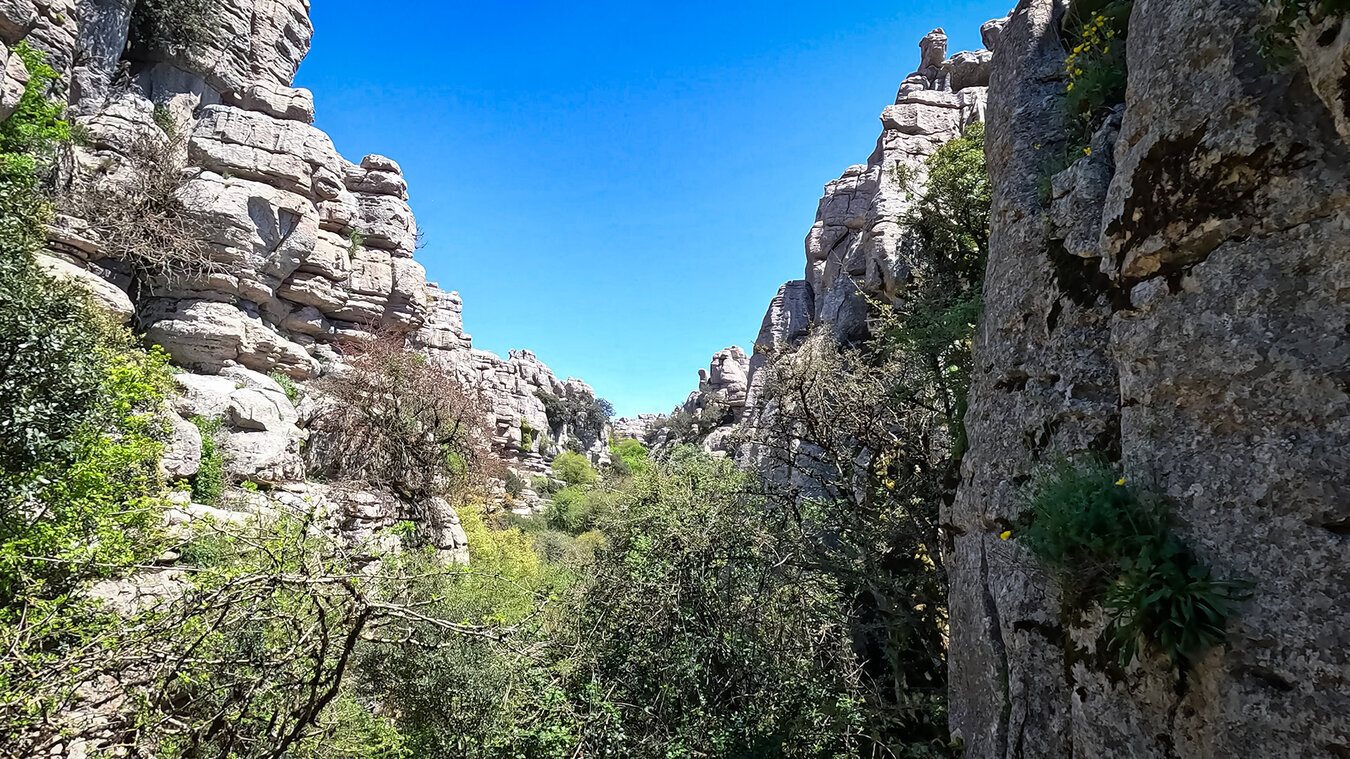
Anyone hiking through El Torcal in April expecting nothing but rock is in for a surprise. Wild peonies bloom among the limestone towers, cushions of blue-violet hedgehog broom hunker down on bare rock slabs, and in local hollows the Antequera catmint stands in full flower – a plant found nowhere else in quite this way.
In total, over 600 plant species have been recorded in the nature park, with some sources citing as many as 664. For a karst massif of 17 square kilometres – an area that at first glance looks hostile to life – that is a remarkable figure. Six orchid species even occur here exclusively. The EU has therefore recognised the park as especially worthy of protection.
Anyone carrying binoculars shouldn’t reach for them only for the birds of prey. The most fascinating stories of the karst flora play out at ground level.
Why so much flora grows here
The karst looks parched. In reality, it stores water better than most soils in Andalusia: inside the massif lies one of the region’s largest groundwater reservoirs, which seeps out in carefully metered amounts through thousands of rock fissures above. Wherever this water emerges, plants grow that would long since have died of thirst anywhere else.
Added to this are special microclimatic conditions. The sheer rock faces cast shade that in places stays a few degrees cooler than on the plateau. Moisture collects in the gorges, while the sun blazes down on the south-facing slopes. Across 17 km² there are therefore so many different habitats that the plant world can occupy every ecological niche.
Sheep, gorges, shade – the habitats
Four habitats shape the flora above all. Scrubland makes up the bulk of the park: shrub-covered terrain with hawthorn, barberry, elder, wild roses, fennel and rosemary – and, of course, the wild peonies. The grassland, locally known as “Encerraderos”, consists of flat hollows between rock ledges. These have served as sheep pasture for centuries, while buttercups, hairy knapweeds and Antequera catmint grow here too.
The rocky terrain itself – bare karst surfaces with extreme conditions – is home to ivy, which sends its roots into the finest cracks, along with mosses, ferns and twelve different lichen species. Here and there among the rocks grow shrubs and trees too: juniper, rock rose, Montpellier maple, holm oak, Portuguese oak and even wild aloe.
Peonies, hedgehog broom, catmint – the three stars
Out of this diversity, three plants stand out as defining the karst massif like few others. One for its striking flowers, one for its adaptation to bare rock, one for its rarity.
Wild peonies in the scrubland
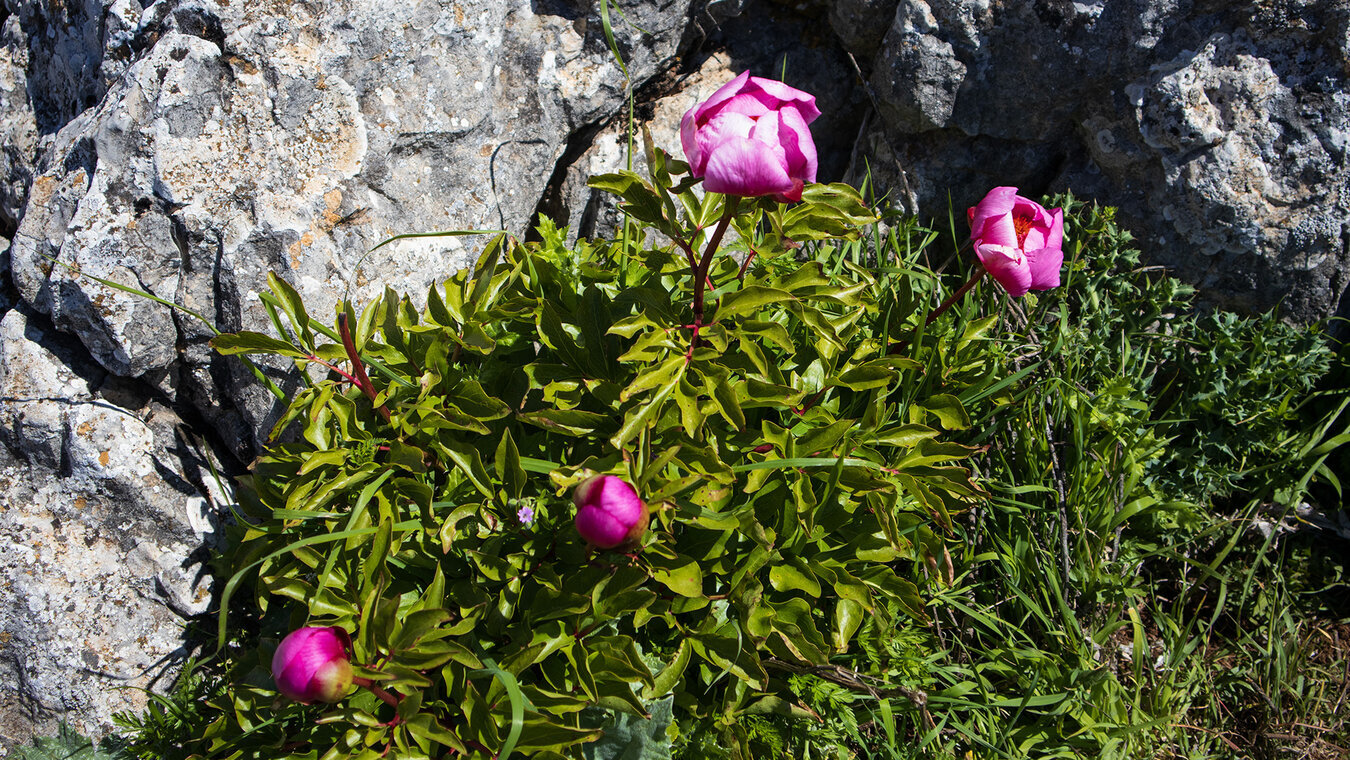
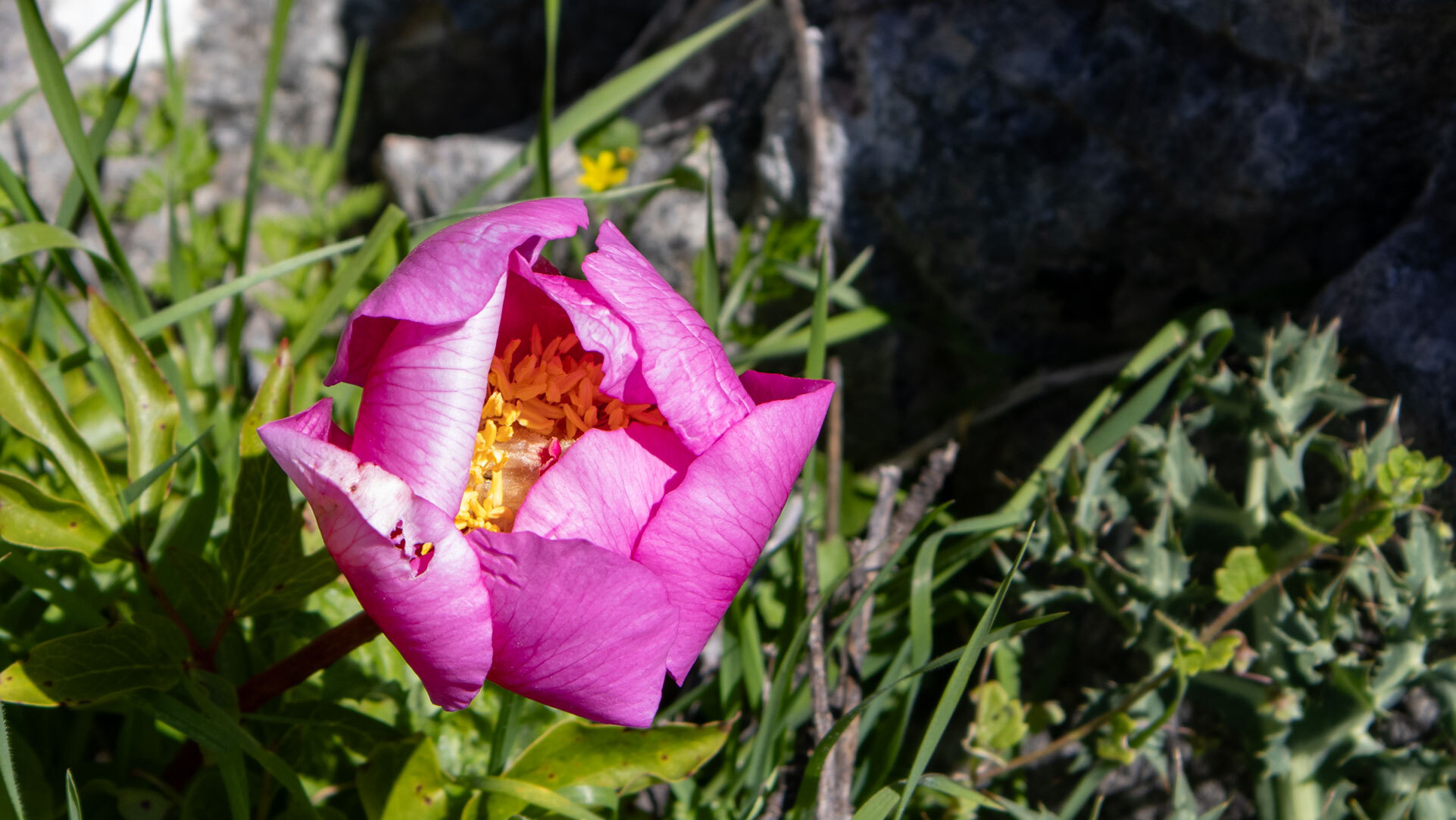
The wild peony (Paeonia broteri) is one of the plants that turns the hiking trails of El Torcal into splashes of colour between March and May. Its deep red flowers are large, bowl-shaped and unmistakable – several centimetres across, often in loose clusters along the path edges or down in the gorges, where the microclimate stays more humid.
The species is widespread across the western Mediterranean, but not found everywhere in Andalusia. El Torcal is one of its reliable sites. Anyone hiking here in April is almost guaranteed to see them – anyone arriving in August will find only dry seed capsules. Picking is not permitted: the plant is protected, and even taking a single flower can weaken the local population.
Hedgehog broom – the cushion plant on the rock
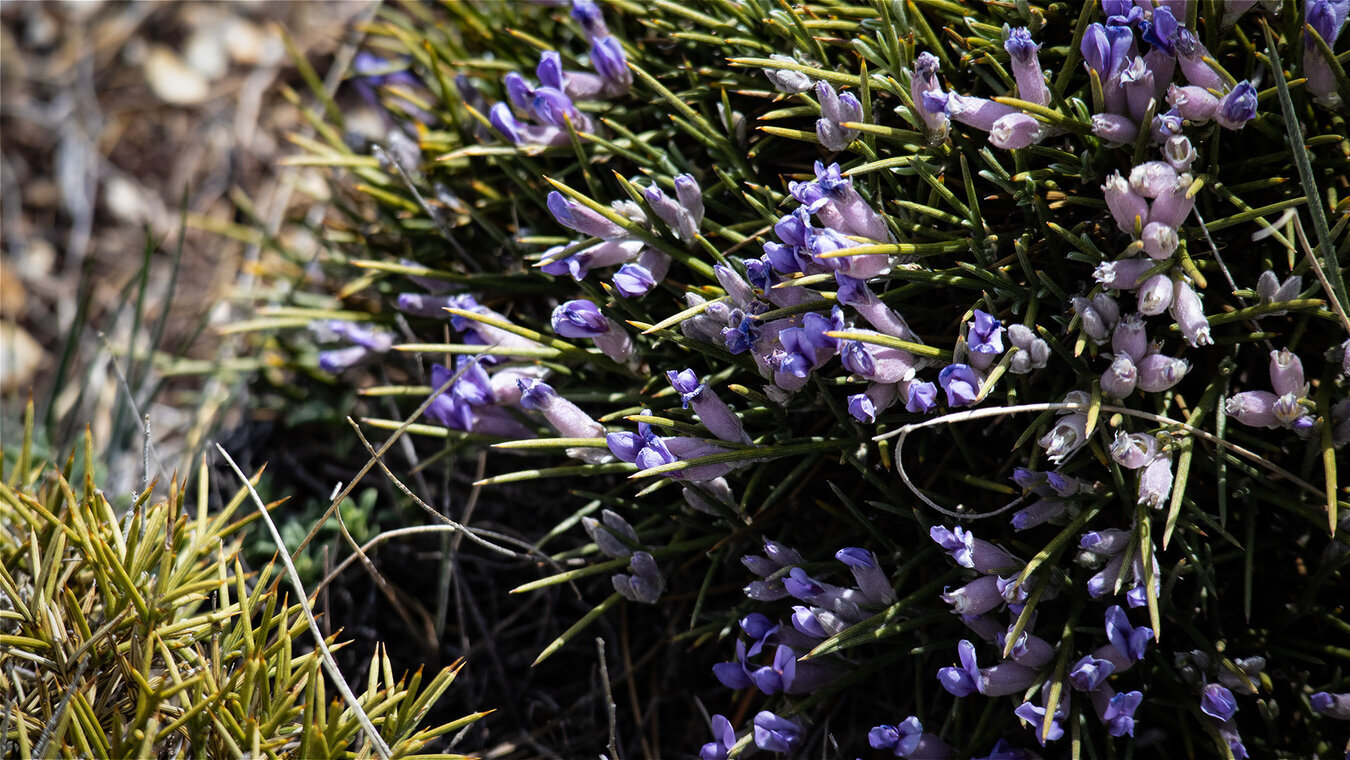
Hedgehog broom (Erinacea anthyllis) is probably the most unusual plant in the park. From a distance it looks like a thick, grey cushion bush sitting on the bare rock slab. Up close you see what it really is: a dense tangle of hard, pointed shoots without leaves, studded with tiny blue-violet pea flowers that light up for a few weeks in April and May.
The cushion shape is an evolutionary response to the karst. Wind, sun, grazing sheep and drought – hedgehog broom makes itself small, dense and spiny, surviving where other shrubs would wither within a single season. It is protected in Spain, and in El Torcal it is especially common on exposed rock ledges and across the plateau areas.
 Hedgehog broom (Erinacea anthyllis)
Antequera catmint – endemic to the Encerraderos
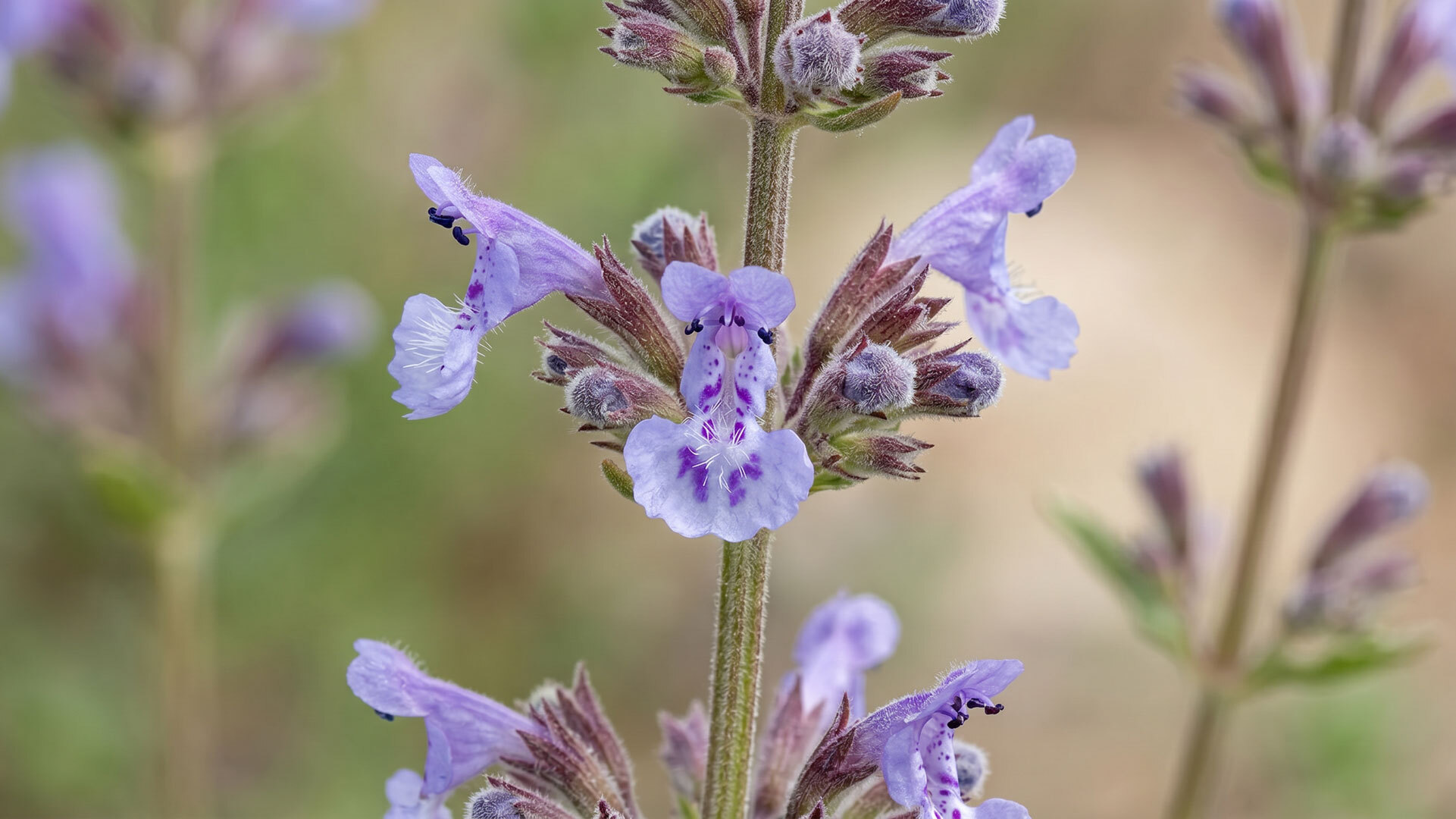
Antequera catmint (Nepeta amethystina) is the park’s secret star plant: an endemic of the local karst hollows, with delicate flower spikes in a clear shade of lilac – the source of its Latin epithet, “amethystina”, meaning amethyst-coloured. It grows only in the Encerraderos, those flat meadows between rock ledges where a little more moisture lingers during the day.
Anyone wanting to find the plant should head onto the plateau in May or June and look at the transitions between scrubland and rocky terrain. Unlike the peony, it is not brashly red but a subtle violet – and precisely for that reason easy to overlook. Botanically it belongs to the mint family, making it a distant relative of garden catmint.
Wild orchids – over 30 species, from orchids to bee orchids
Over 30 species of wild orchid have been recorded in El Torcal – a remarkable density across 17 square kilometres of karst. All of them are strictly protected: picking, digging up or damaging them is prohibited.
Among the most striking species are Lange’s orchid (Orchis langei) with its violet flower crowns, Champagneux’s orchid (Anacamptis champagneuxii) in dense, deep-violet clusters, the Italian orchid (Orchis italica) – nicknamed the “naked man orchid” because of its flower shape – and the pyramidal orchid (Anacamptis pyramidalis) with its pink-purple flower pyramids.
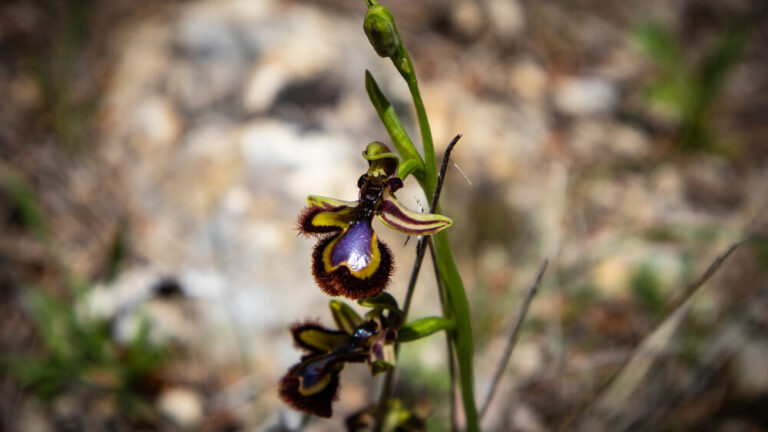
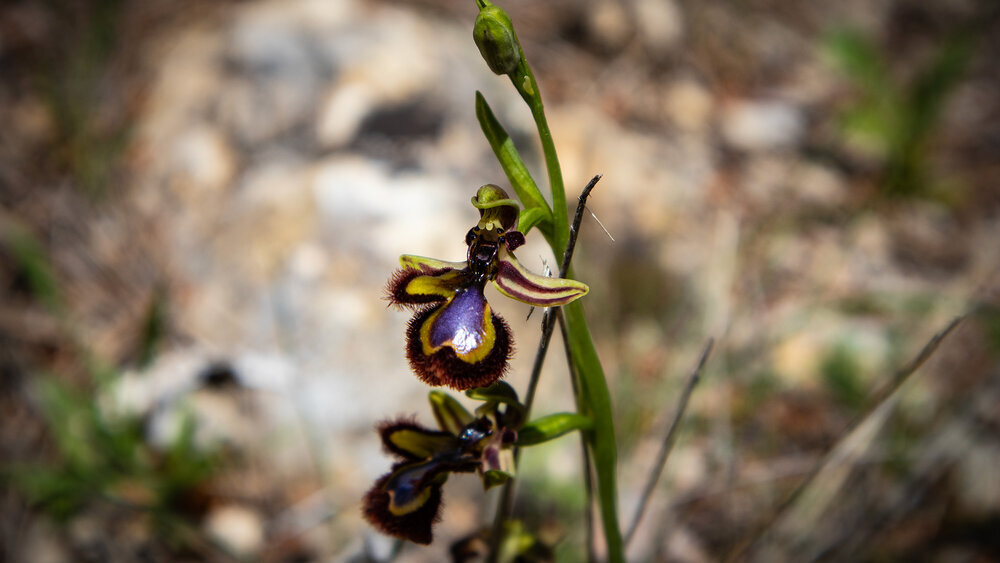
Especially ingenious are the bee orchids (genus Ophrys), which are pollinated through insect mimicry: the mirror orchid (Ophrys speculum) has a glossy blue lip that lures male insects into attempting to mate with it. The bumblebee orchid (Ophrys scolopax) imitates the appearance and scent of female insects. The brown orchid (Ophrys fusca) is one of the earliest to flower – often found as early as late winter.
When and where they bloom
The main flowering season runs from March to May, depending on how wet the winter was. April and May are the most rewarding weeks. Anyone wanting to see orchids should move slowly and keep their eyes on the ground – most species are small, often only ten to thirty centimetres tall, and stand among the grasses. The Encerraderos are particularly rewarding, since sun and moisture come together there.
A plant identification app on your phone helps – the family is large, and many species look similar. A detailed overview of the typical orchids, with identifying features, can be found under Wild Orchids in El Torcal.
From the ground to the canopy – trees and shrubs in the karst
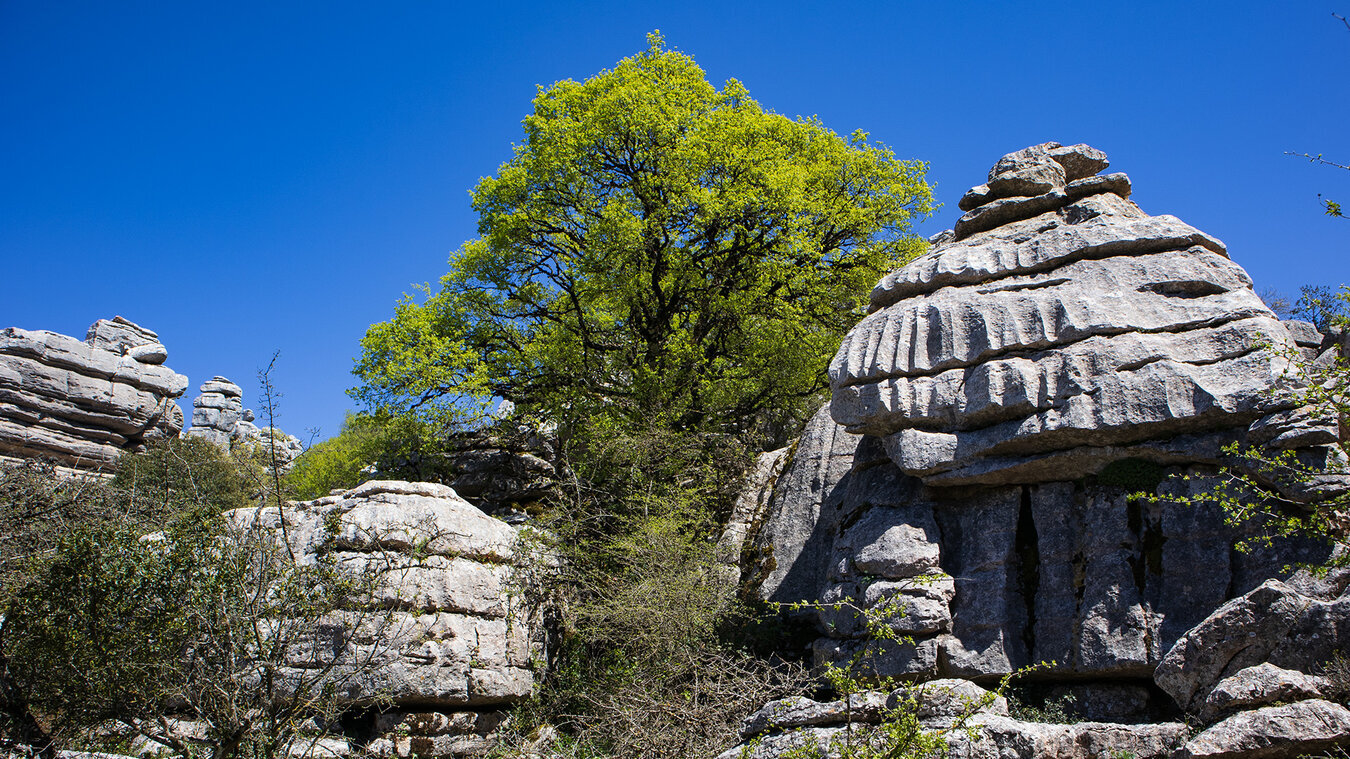
There are fewer trees in El Torcal than in some other parts of Andalusia, but those that are here are something special. The holm oak (Quercus ilex) and the Portuguese oak (Quercus faginea) are the nature park’s most important large trees – both hardy, both adapted to drought, and both used for centuries by shepherds and hikers as a source of shade.
Holm oak, Portuguese oak, Montpellier maple
The true star among the trees, however, is the Montpellier maple (Acer monspessulanum), regarded as the region’s emblematic tree and listed in the “Red Book of Threatened Wild Plants of Andalusia”. In autumn its three-lobed leaves turn a brilliant yellow-orange – a colourful contrast to the grey karst. A particularly old specimen along the Ruta Verde, the “Arce de la Ruta Verde”, is protected and has become an attraction in its own right for botanists.
On the lower slopes grow juniper and rock rose, both with aromatic resins that lend a distinctive scent to the hot midday air. Those who look closely will even spot the occasional wild aloe plant – a feral relative of its garden counterpart that has become permanently established here.
Tips for plant-watching in El Torcal
Best time
April and May for peonies, hedgehog broom and most orchids. Antequera catmint peaks in May/June. Autumn for the Montpellier maple’s colour change in October/November.
Time of day
Morning, when the sun is low and the karst rock is still cool – plants don’t look shrivelled at that point, and the light is better for photos.
Locations
Ruta Verde for the Montpellier maple · the Encerraderos between scrubland and rocky terrain for orchids and catmint · gorges and path edges for peonies.
Equipment
A plant identification app on your phone, a small magnifying glass for orchid detail, knee pads or a sitting mat for ground-level shots. Sturdy footwear is essential.
Conduct
Stay on waymarked paths · pick nothing · do not touch the plants · photograph populations from a respectful distance – the protected area is safeguarded under EU law.
Conclusion – peonies, hedgehog broom and Antequera catmint in El Torcal
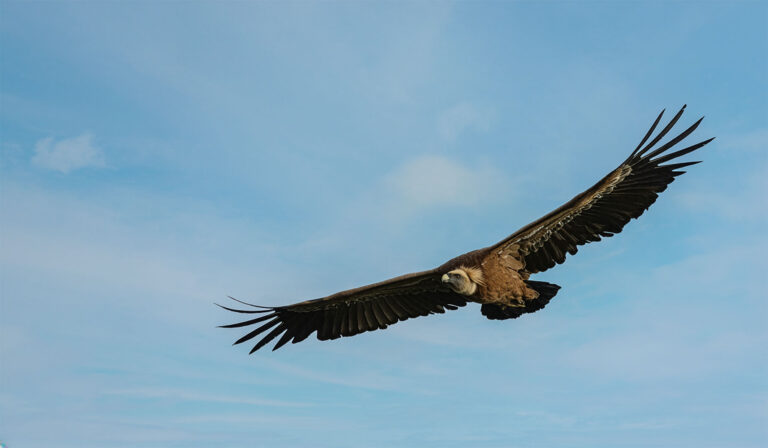
Over 600 plant species across 17 square kilometres of karst, 30 wild orchid species, three unmistakable emblematic species: El Torcal is one of the botanically richest protected areas in Andalusia. Anyone wanting to see the Antequera catmint should come in May or June. Anyone wanting peonies should come in April. Anyone who sees the hedgehog broom in bloom has had a good day regardless. The 30 orchid species deserve a walk of their own, the Montpellier maple deserves its own autumn visit, and the birds of prey above the karst are the animal counterpart to the quiet flora below. Overview of the nature park: Karst landscape of El Torcal.
Frequently asked questions
When is the best time for plant-watching in El Torcal?
Where do the peonies grow in El Torcal?
What is the Antequera catmint?
How many plant species are there in El Torcal?
Are you allowed to pick plants in El Torcal?
This article is based on the on-the-ground knowledge of the Gequo editorial team – publishers of several Reisezeit hiking guides and operators of Sunhikes.com. Last updated: May 2026