Iberian ibex in El Torcal: emblem of the karst world – and where to encounter it
There are encounters in El Torcal you simply can’t plan. You walk along a rock passage, turn round, and suddenly, ten metres further on, an animal is standing at the edge of the path: stocky, sandy-coloured, with horns curving backwards. The Iberian ibex. Before you can reach for the camera, it turns its head, leaps onto a rock slab in two bounds – and is gone.
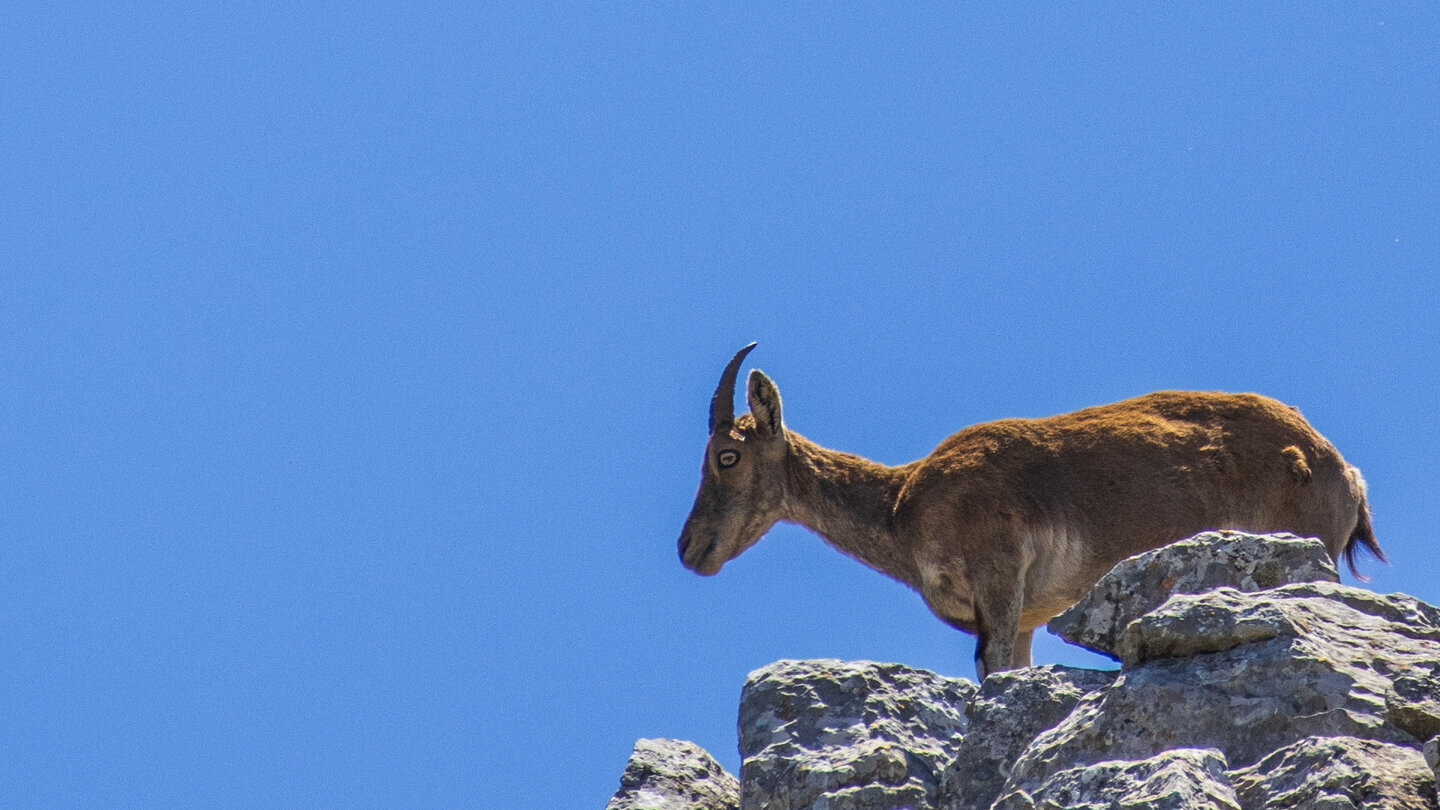
Such moments are not rare in El Torcal. The park is home to a stable, actively protected population of Capra pyrenaica. Anyone out early enough, with a bit of luck and a quiet step, sees them regularly: lone males on a lookout rock, females with young in the morning sun, whole groups below the Sombrerillo.
The Iberian ibex is one of the park’s two great wildlife emblems – alongside the griffon vulture, which circles above the massif. While the vulture rules the sky, the ibex owns the rocks. Both species live in a protected area that has been designated a Paraje Natural since 1978 and a ZEPA bird protection area since 2002. But whereas the vulture is on an EU list, the ibex is above all a success story of Spanish species conservation.
Fact file – the essentials at a glance
Scientific classification and habitat
The Iberian ibex is a true wild goat species found only on the Iberian Peninsula. El Torcal is one of its core areas in Andalusia.
| Scientific name | Capra pyrenaica |
|---|---|
| English name | Iberian ibex · Spanish ibex · Iberian wild goat |
| Family | Bovids (Bovidae), wild goat genus |
| Distribution | endemic to the Iberian Peninsula (Spain and Portugal) |
| Habitat in El Torcal | Karst plateau at 1,100–1,400 m, highest point Camorro del Mástil at 1,348 m |
| Status in El Torcal | stable, actively protected population – regularly observed |
| Identifying feature | sturdy, backward-curving horns (especially in males), sandy-coloured coat |
| Activity | mainly active in the morning and evening; rests through the midday heat |
| Protection status | actively managed within the park; protected under hunting law in Andalusia |
| Best places to spot them | Ruta Verde, Ruta Amarilla, more remote rock ledges of the Grand Circuit |
Identifying features: how to recognise Capra pyrenaica
Build, coat, and the crucial look at the horns
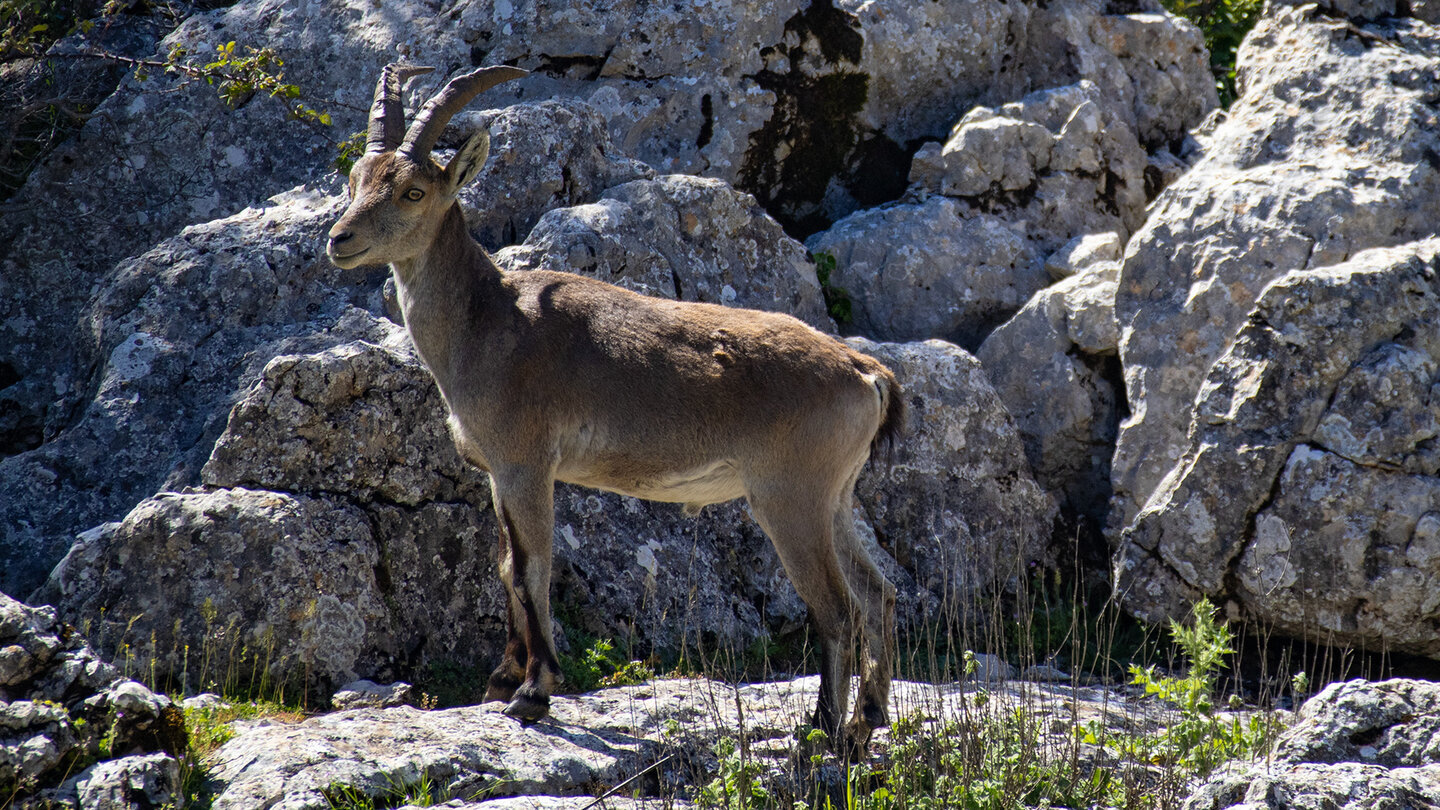
Anyone seeing the Iberian ibex in the wild for the first time is surprised how compact the animal looks. Males reach up to 80 cm shoulder height and 60–80 kg in weight. Females are smaller and lighter, with a narrower head. Both have a broad chest and powerful hind legs – the equipment needed for vertical karst walls.
The coat is sandy to grey-brown, darker and denser in winter, lighter in summer. Black lines run along the legs and across the forehead. Young animals are lighter, almost golden-brown, and do not yet have visible horns.
The decisive identifying feature is the horns – and here the sexes differ markedly. Males carry massive horns that curve backwards and outwards, with knots and ridges that grow with age. Females have short, slender, almost straight horns – if you see an animal with small horns, it is a female, often with a young one nearby.
Ibex live in loose social groups. Males often stay in bachelor groups, while females form family groups with their young. Only during the rut in late autumn and winter do the groups mix – which is when the horn-clashing fights familiar from nature documentaries take place.
Habitat: why El Torcal is an ibex paradise
Karst plateau, altitude, and protection since 1978
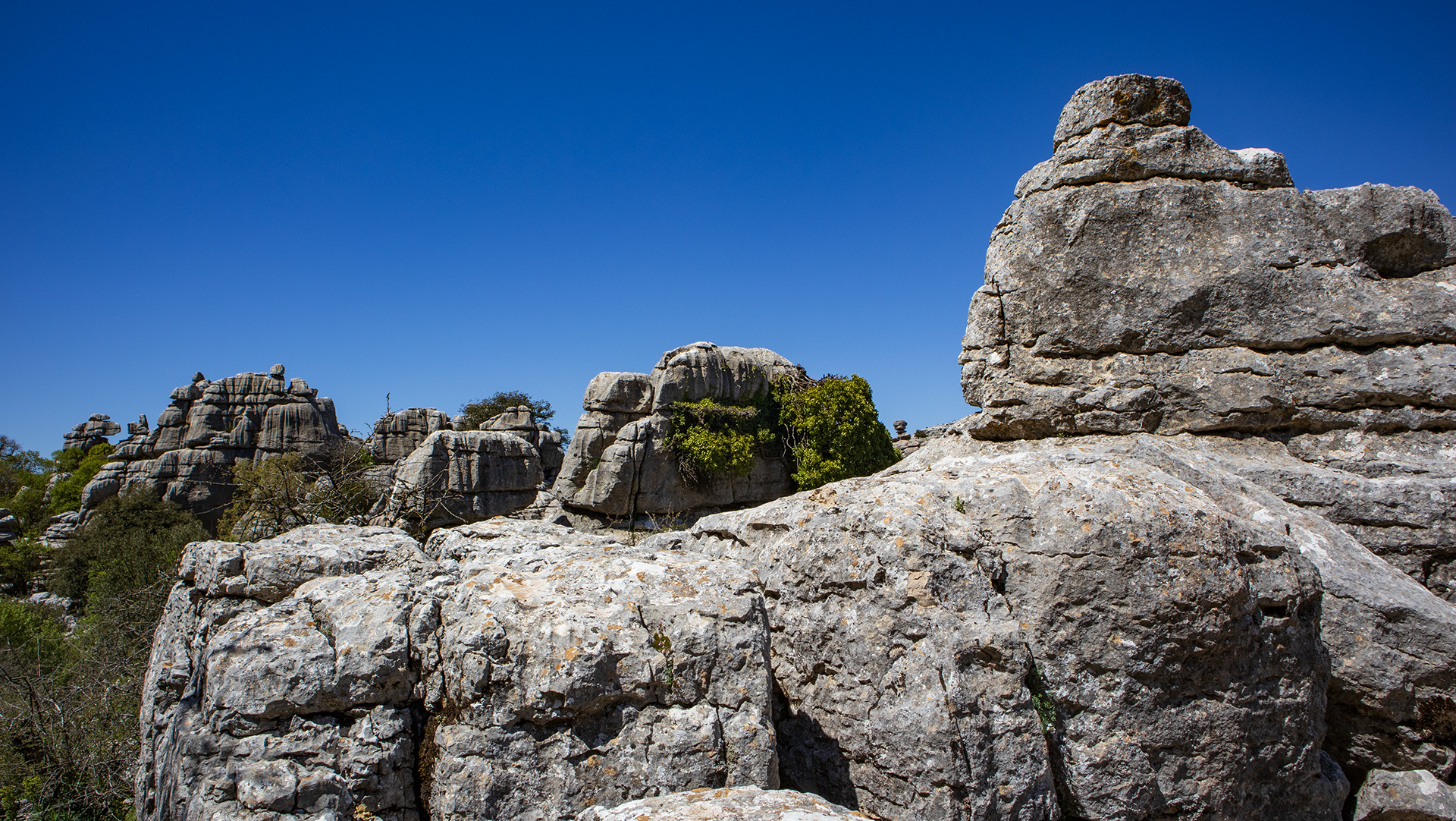
Ibex need three things: vertical rock faces, low vegetation, and a habitat where they are largely undisturbed. El Torcal meets all three conditions in almost ideal fashion.
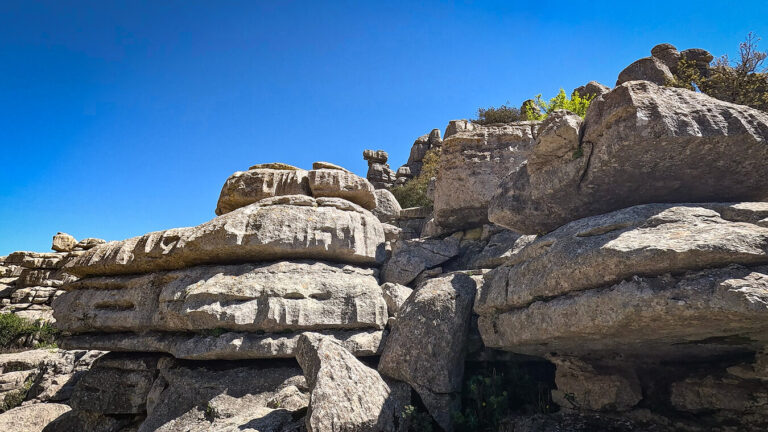
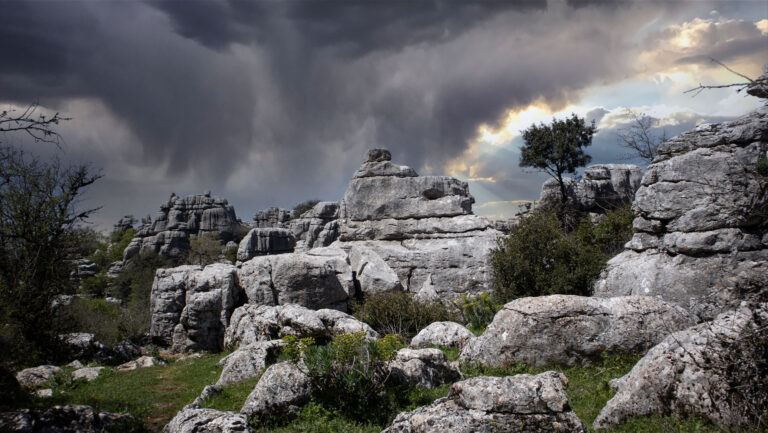
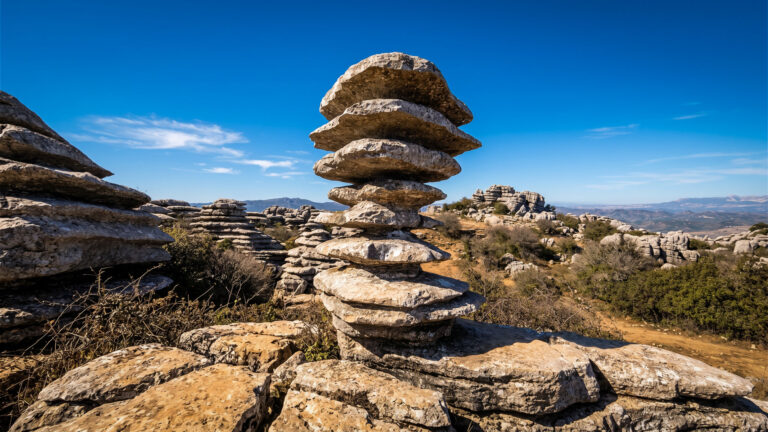
The karst plateau, at an altitude of 1,100 to 1,400 metres, consists of jagged limestone blocks, rock towers, and small hollows. For an ibex, this is three-dimensional terrain – it moves vertically just as fast as horizontally. Vertical rock faces that are a dead end for walkers serve as a fast track for the ibex. This is also why ibex have hardly any natural predators: neither fox nor dog can reach them once they are standing on a rock ledge.
The vegetation of El Torcal provides just the right food. Grasses, cushion plants, herbs, young shoots of Portuguese oak and holm oak grow here, along with broom and Mediterranean shrubs. Anyone watching the animal graze sees how selective it is – a bite here, a bite there. In winter, when choice becomes scarcer, the ibex falls back on lichens and mosses growing on rocks and tree trunks.
The animal needs surprisingly little water: it covers most of its fluid requirements through the moisture in its food. If you see an ibex in an unusual spot, persistently licking a rock, don’t get too close: it is probably making use of a salty mineral seam.
The decisive protection from human disturbance comes from the Paraje Natural status held since 1978. Hunting is banned in the park, and there is no mountain biking or freeriding. On top of that comes the ZEPA bird protection area designation since 2002: whatever protects the griffon vulture also indirectly protects the ibex, because the whole area remains undisturbed.
It’s interesting how the animals have come to terms with tourism. When there is heavy footfall on the waymarked routes, the ibex withdraw into less-visited areas – higher rock ledges, remote hollows, the harder-to-reach Grand Circuit. From a safe distance, they evidently enjoy watching what goes on below on the paths. Anyone who takes a longer break in a quiet spot and stays still often has the experience of suddenly spotting an animal 50 or 80 metres away on the opposite slope, calmly sizing them up.
Where and when to spot ibex
Routes, time of day, behaviour – what matters
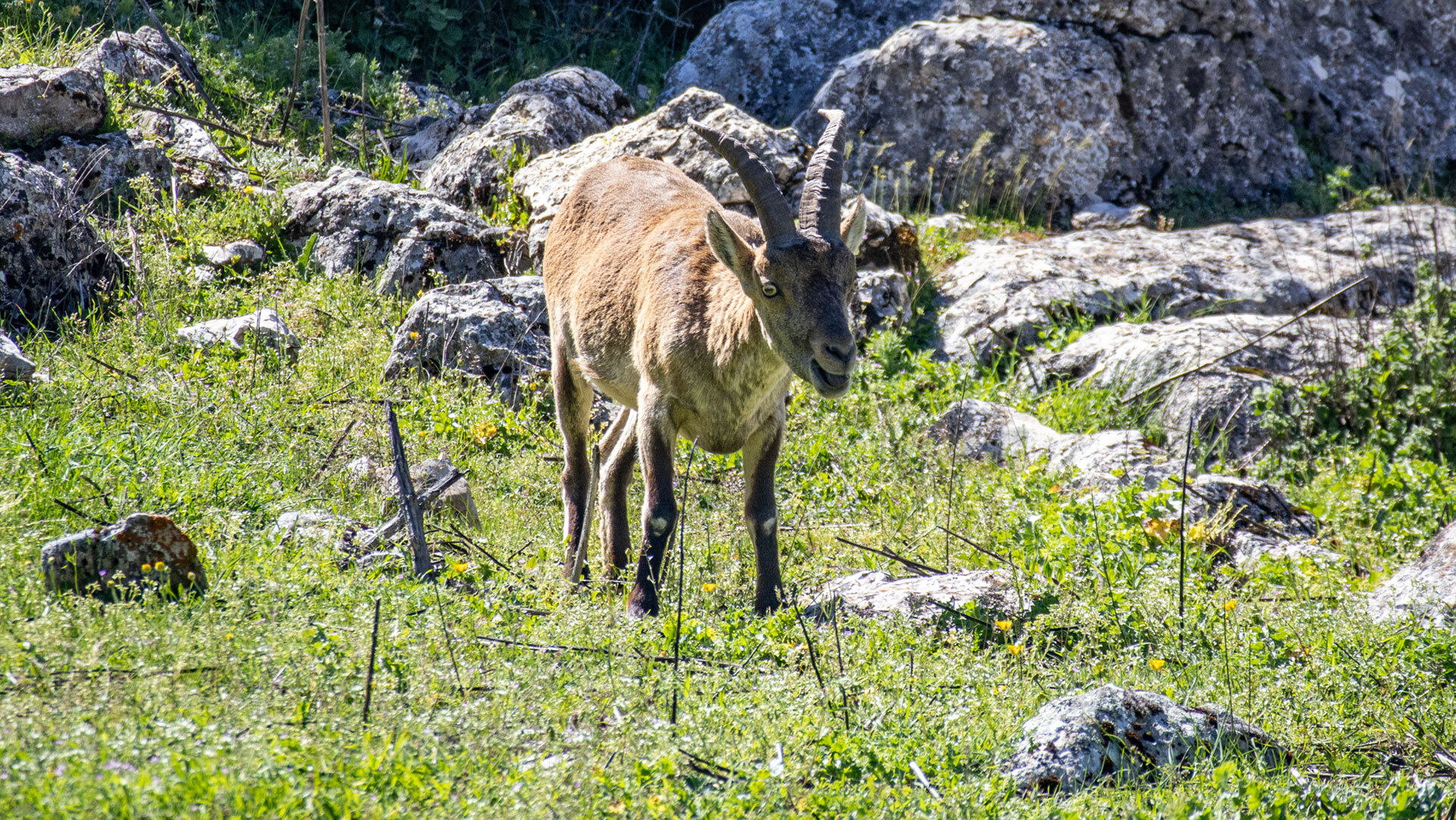
Ibex are not a rare sight in El Torcal. Anyone spending half a day in the park will very likely see at least one – sometimes whole groups. It comes down to timing.
The best times of day are early morning (from 9 a.m., shortly after the visitor centre opens) and late afternoon (from 5 p.m. in summer, earlier in winter). During the hot midday hours, the animals retreat into shade – into rock crevices, under overhangs, into higher areas.
The Ruta Verde, the short green karst circuit, runs through a rocky area where ibex often graze right at the path’s edge. The Ruta Amarilla, through the rock labyrinth, offers similar viewing opportunities, often with an ibex on one of the higher rock platforms. Anyone taking the Grand Circuit – not waymarked, pathless in places, only for experienced walkers with a GPS track – reaches more remote rock ledges, where the animals can be observed even more calmly.
Your own behaviour matters. Ibex don’t vanish at the first sound, but they do react to sudden movements, loud voices, and above all to dogs. Walking slowly, speaking quietly, and stopping as soon as you spot an animal gives you the best chance of a longer sighting. A pair of binoculars (8×) helps you make out details from a respectful distance.
Rules of conduct: what you may do – and what you may not
Keep your distance, stay calm, give the animal space
El Torcal is a protected area, and that applies to how you treat the ibex too. If you see an animal, you don’t need to do anything special – just refrain from the usual things: don’t get too close, don’t feed it, don’t stage it for a selfie. Ibex lose their wariness when they have positive experiences with people – and that is dangerous for them, because it can lead them onto car parks or roads.
Drones are banned throughout the nature park – for ibex-watching as for any other activity. The ZEPA status formally protects the birds, but drones also trigger considerable stress reactions in mammals.
Rules of conduct for observing the Iberian ibex
Distance: at least 30 metres, more when mother animals have young with them
Movement: slow and calm, without frantic to-ing and fro-ing
Voice: quiet, no loud calls, no whistling
Dogs: on a short lead – even if your own animal is „friendly“
Feeding: never – not even „just this once“
Drones: strictly forbidden throughout the park
Photos: use a telephoto lens or binoculars instead of approaching
Alongside the griffon vulture and the karst landscape
Ibex and vulture share the same space
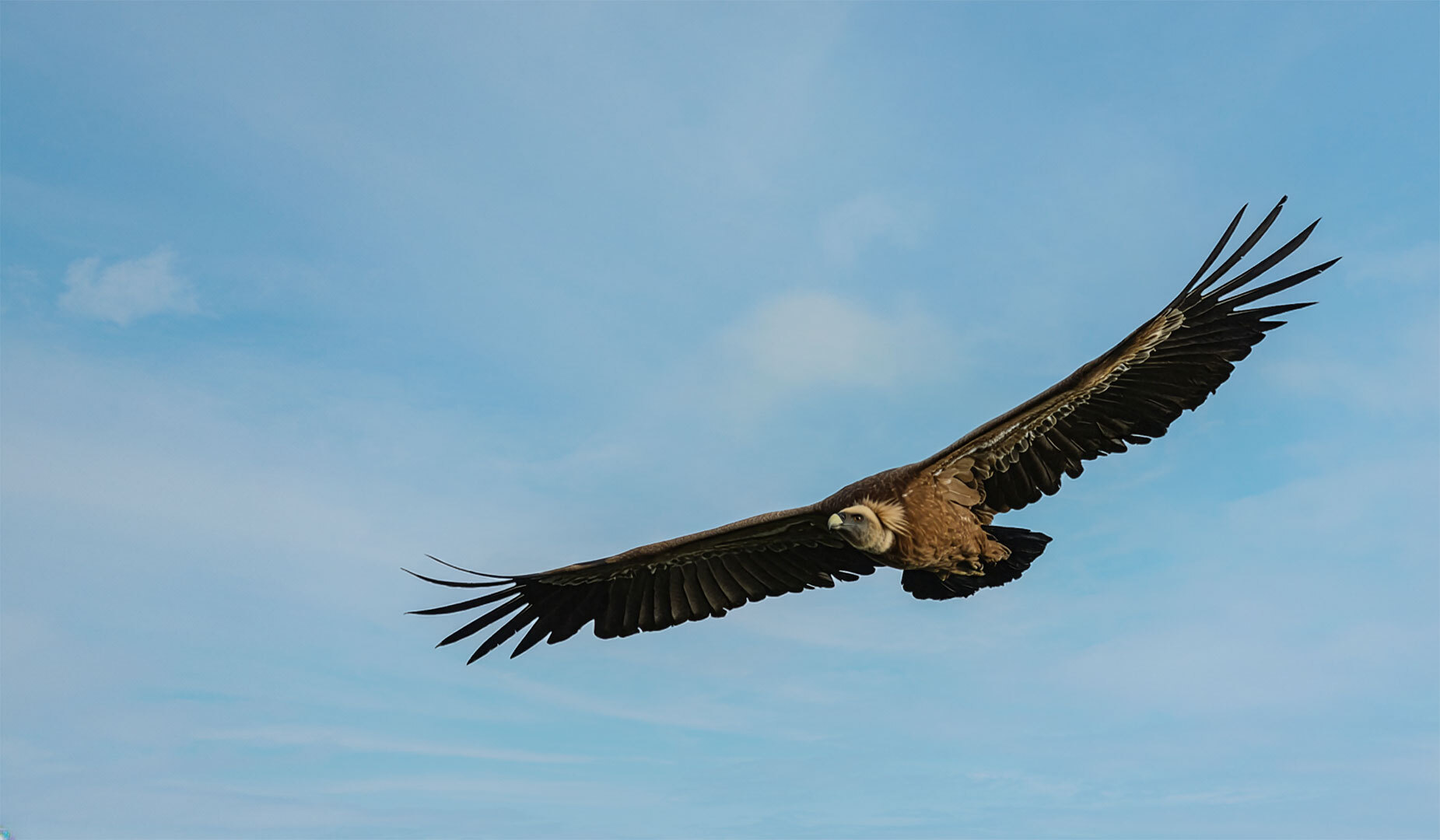
The Iberian ibex is not the only emblematic animal of El Torcal. Above it, griffon vultures circle on the updrafts over the limestone slabs. Golden eagles, Bonelli’s eagles, peregrine falcons, and eagle owls nest in the rock crevices. This diversity of birdlife was one of the main reasons El Torcal was declared a ZEPA bird protection area in 2002.
For walkers, this creates a double nature experience: on the ground, the compact ibex grazing quietly; in the sky, the vultures gliding on outstretched wings. Anyone planning a full day in El Torcal can combine a morning walk focused on the ibex with a break at the Mirador Las Ventanillas, where the circling vultures are best observed.
Both species benefit from the same protective backdrop. They are embedded in an ecosystem home to a total of 116 vertebrate species – 22 mammals, 82 birds, 11 reptiles, and 1 amphibian. The ibex is just one of many inhabitants – but the most spectacular one on four legs.
Conclusion: a wild animal you almost never have to search for
The Iberian ibex is the quieter emblem of El Torcal – but not the rarer one. Anyone who sets off early enough and stays respectful sees it almost every time.
A stable population, clearly identifiable, in a protected area that gives it peace – Capra pyrenaica in El Torcal is a success story of Spanish species conservation. It shows that a well-managed nature park need not be just a walking area, but can also be a refuge where wildlife shows itself again.
Continue on to the Griffon Vulture of El Torcal, to the Paraje Natural Torcal de Antequera, to the Birds of Prey in El Torcal, and to getting there. Back to the El Torcal overview
Frequently asked questions about the Iberian ibex
How good are the chances of seeing an ibex in El Torcal?
Are Iberian ibex dangerous to walkers?
What distinguishes the Iberian ibex from the Alpine ibex?
Are you allowed to feed or photograph ibex in El Torcal?
Are there fixed observation points for ibex in El Torcal?
This article is based on the on-the-ground knowledge of the Gequo editorial team – publishers of several Reisezeit hiking guides and operators of Sunhikes.com. As of: May 2026