Ruta Verde in El Torcal: 1.8 km through the rock labyrinth – the perfect introduction
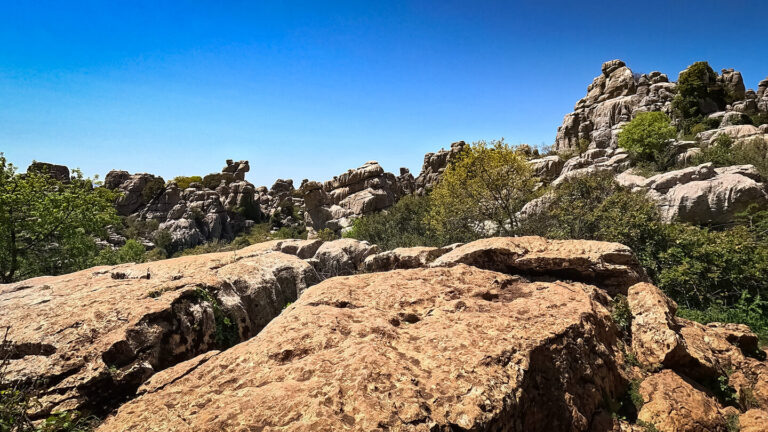
Sometimes the shortest walk is the most striking. The Ruta Verde in El Torcal measures just 1.8 kilometres, yet it still conveys everything that makes this karst massif so extraordinary. In 45 to 75 minutes you cross a labyrinth of limestone formations that lay on the bed of a tropical sea 150 million years ago. Along the way you meet a sphinx, an eagle, a Native American and a sentinel – all of them rocks that look as though someone placed them here quite deliberately.
The green route is the easiest of the three freely accessible walking trails in the Paraje Natural Torcal de Antequera. It is well waymarked, sure-footed underfoot and ideal for families with children, beginners and anyone who has only a little time but still wants the full Torcal experience. No entry fee, no booking, no hidden difficulty – simply an exceptional walk through one of the most spectacular landscapes in Europe.
And if you want more afterwards, you are in exactly the right place: the Ruta Amarilla sets off from the same point. The Grand Loop officially begins at the car park around 900 metres before the visitor centre, but it can also be started right here as an alternative entry point.
Route & facts: the Ruta Verde at a glance
All the key figures for the green route
| Distance | 1.8 km (circular walk) |
| Elevation change | 54 m of ascent / 54 m of descent |
| Highest point | 1.222 m |
| Lowest point | 1.195 m |
| Duration | 0:45–1:15 hours |
| Difficulty | Easy – sure-footed underfoot, mostly on paths |
| Character | Well waymarked, heavily used, ideal for families & beginners |
| Start / finish | Torcal Alto visitor centre (upper car park) |
| Waymarking | Green marker posts (Ruta Verde) |
| Entry fee | Free |
| GPS-Track | sunhikes.com |
Following the route: what you see on the Ruta Verde
Starting at the visitor centre and your first encounter with the karst labyrinth
The Ruta Verde begins right at the Torcal Alto visitor centre. You leave the car park, follow the green posts and, within a few steps, find yourself surrounded by rock. That shift from tarmac to karst is a surprise every time: the terrain changes at once, the boulders grow taller, the paths narrower, and the sounds of the outside world fade away.
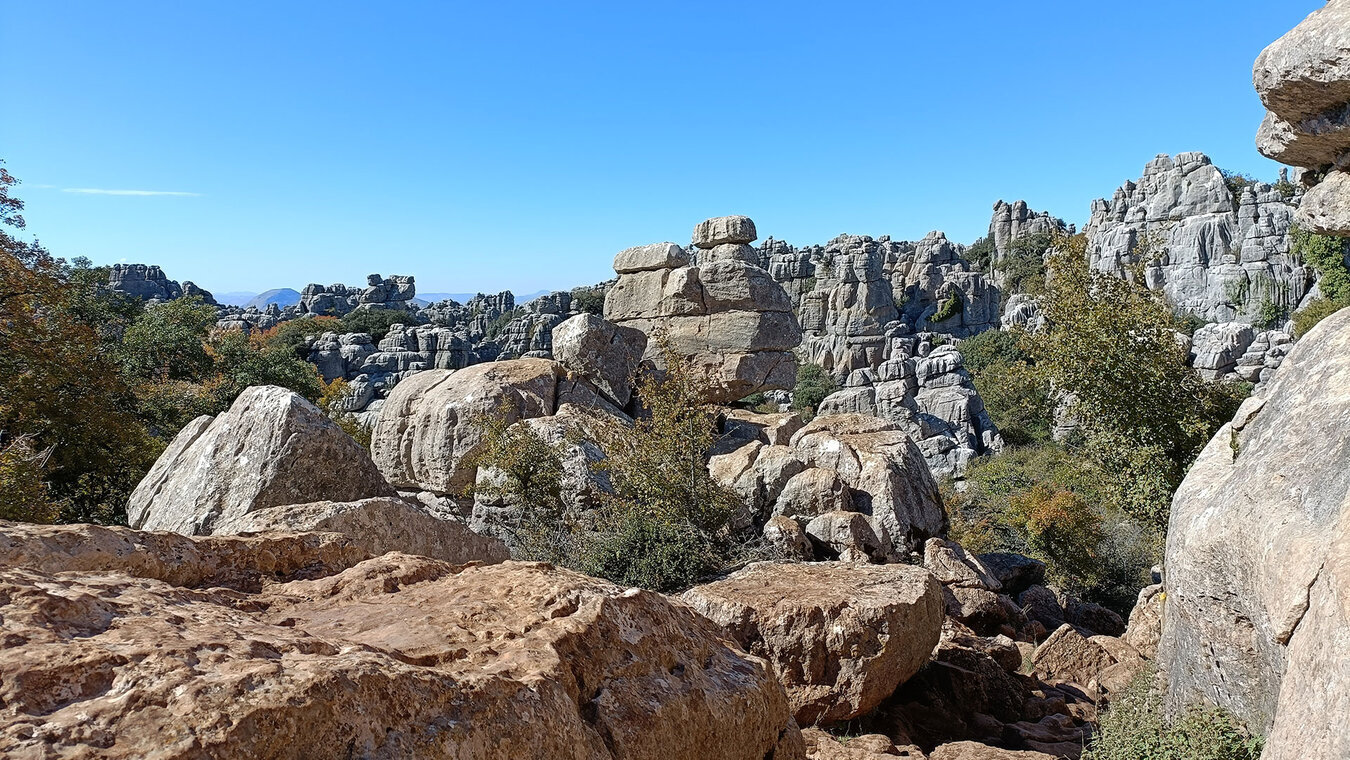
The highlights: rock sculptures, a maple tree and the natural hollow
The Ruta Verde shares its opening and closing stretches with the Ruta Amarilla. At the central fork, the green route branches off – not into the gorges, but down to the Hoyo de la Burra waypoint, a natural hollow that frames the botanical highlight of the walk: the protected Montpellier maple known as the ‘Arce de la Ruta Verde’. This old field maple – no small feat on such a dry, rocky plateau – is the quiet heart of the green route.
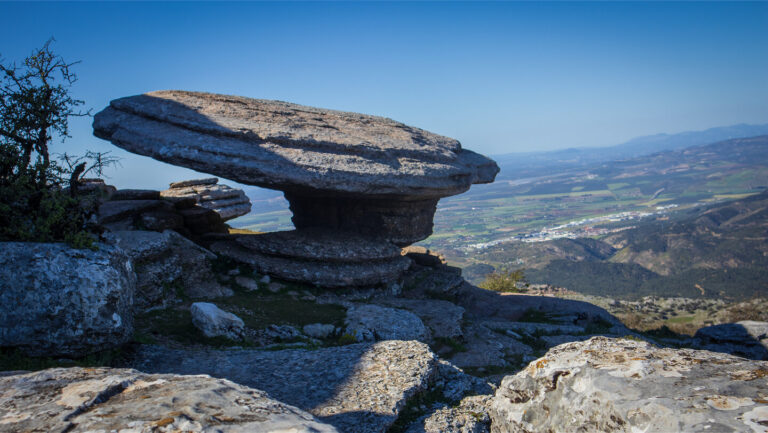
The rock sculptures along the Ruta Verde bear names that match their shapes. La Esfinge (the Sphinx) is a broad block of limestone that gazes out over the terrain like a guardian. El Águila (the Eagle) is unmistakable when seen in profile. El Indio (the Native American) and El Centinela (the Sentinel) are two formations that stand side by side, viewed from the same angle – yet you see something different in each depending on where you stand. That is El Torcal: a karst labyrinth that reinvents itself again and again.
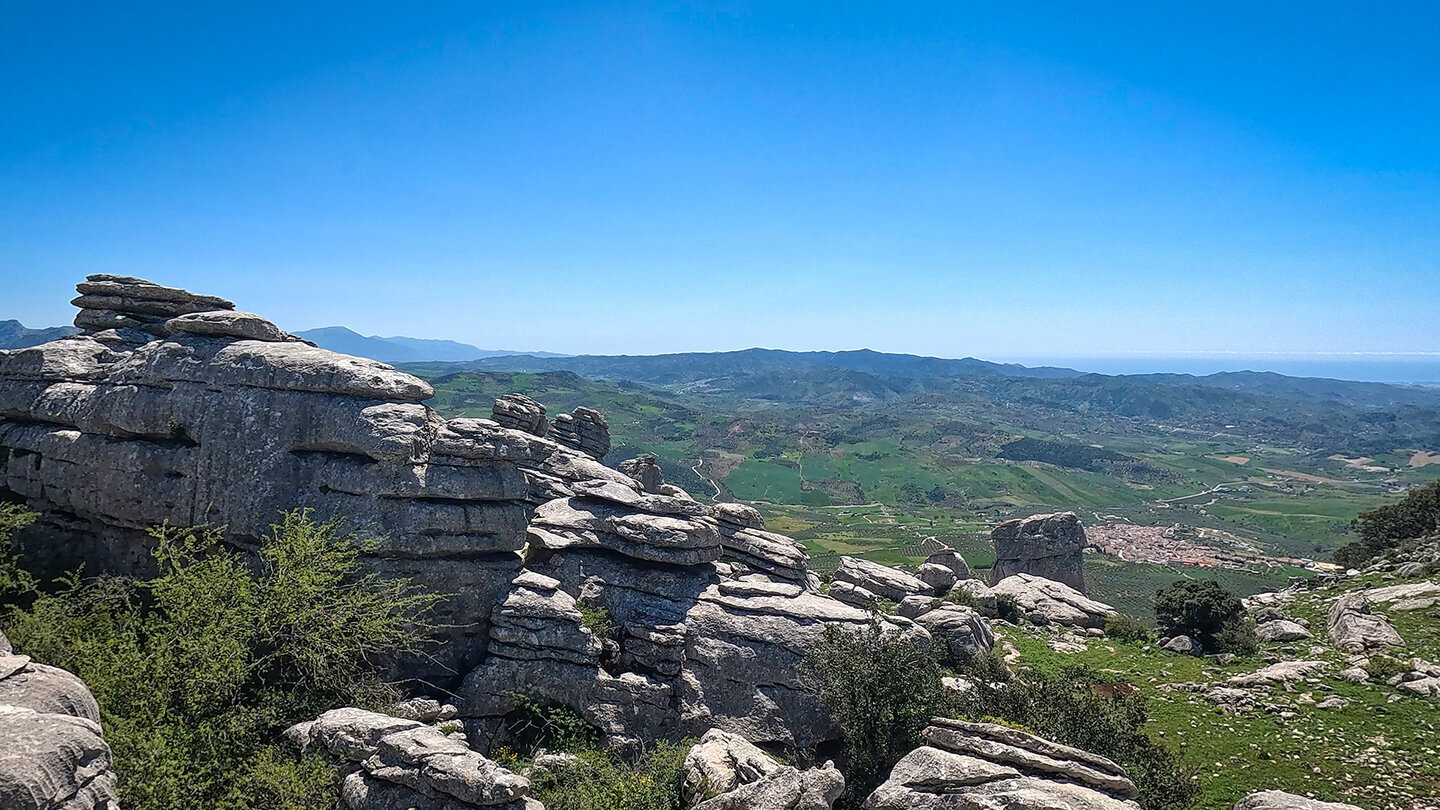
From the Hoyo de la Burra the green route rejoins the yellow one and the two head back together to the visitor centre. A short detour is well worth it: the Mirador de las Ventanillas, just 150 metres from the centre, opens up a view over the valley of the Río Campanillas, across to the village of Villanueva de la Concepción and, on a clear day, all the way to the Málaga coast.
Geology on the Ruta Verde: the karst labyrinth in brief
Why El Torcal looks the way it does
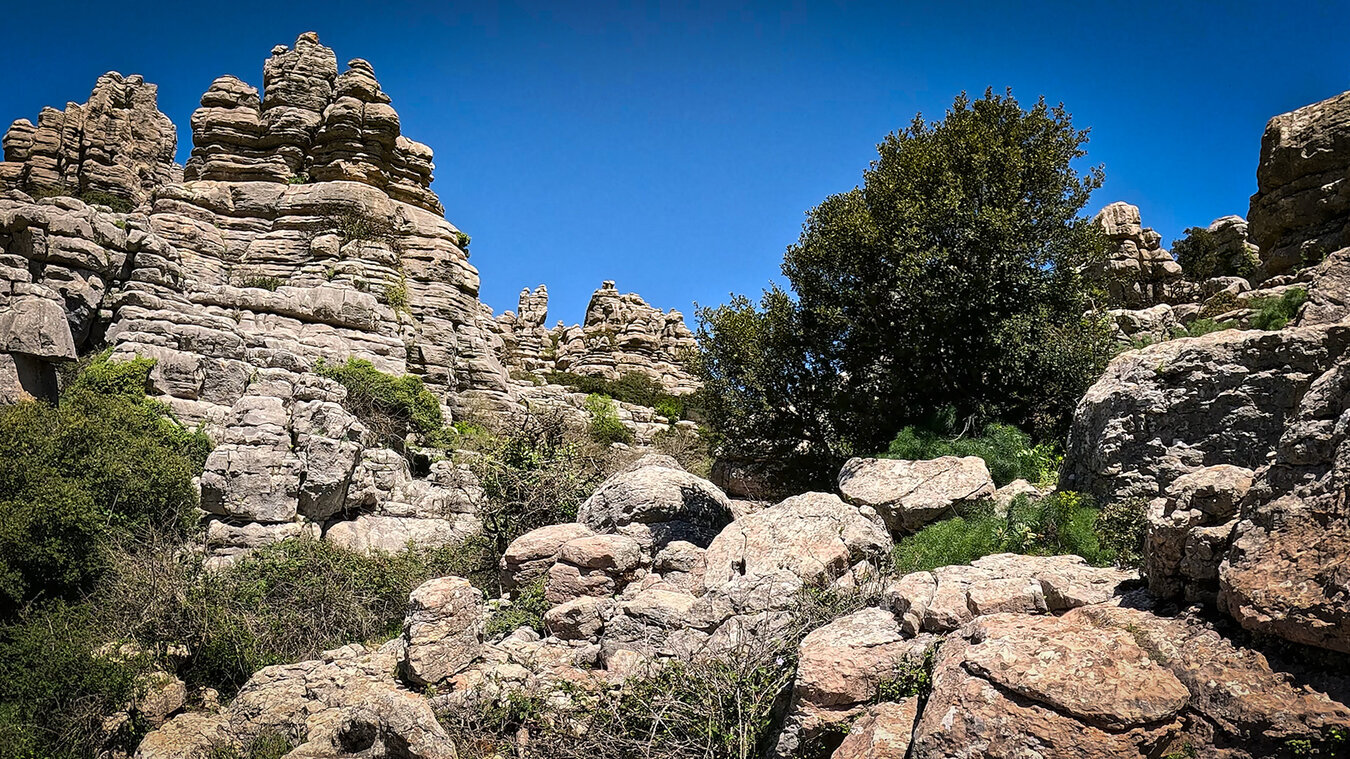
What you see on the Ruta Verde is 150 million years of Earth’s history in compressed form. The limestone of El Torcal formed during the Jurassic on the bed of a shallow tropical sea – layer upon layer of shell debris, coral and marine sediment. Tectonic movements then lifted the entire block by more than 1,000 metres. What followed was erosion: water, frost and wind attacked the softer strata, leaving the harder ones standing as towers, tables and blocks.
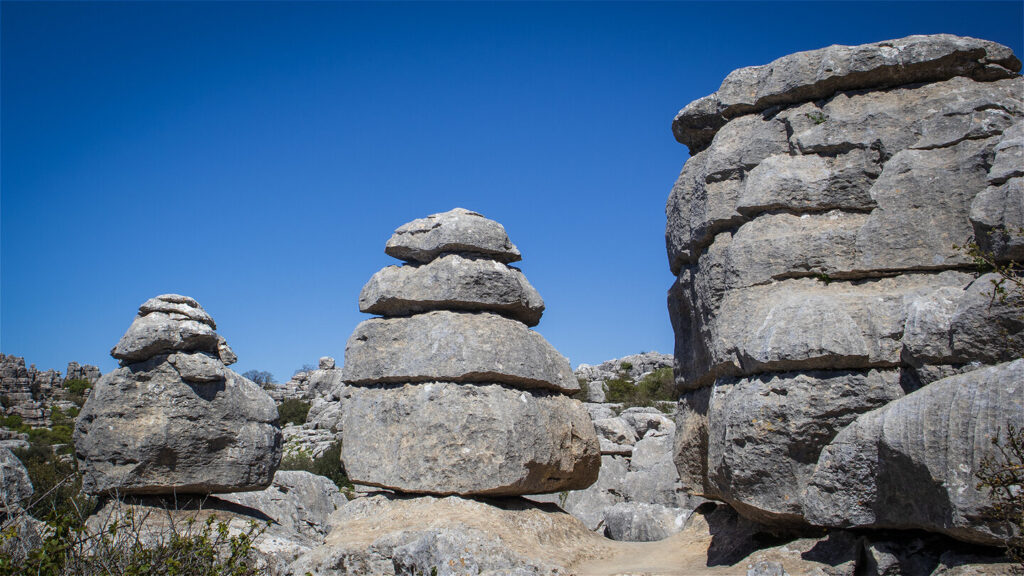
The horizontal lines you can pick out on every rock face along the Ruta Verde are the original layers of marine sediment – as readable as the growth rings in a cross-section of a tree. La Esfinge, El Águila, Las Meninas: none of them owe their form to chance, but to selective erosion over millions of years. Whatever was softer dissolved away. Whatever was harder remained. And so a sculpture park took shape that no sculptor could have laid out any better – only it took 150 million years rather than a single lifetime.
Particularly striking is the group known as Las Meninas – those weathered giant heads of limestone, named after the famous painting by Diego Velázquez. From the right vantage point you really do seem to make out faces: broad foreheads, sunken cheeks, silent mouths. El Torcal invites the imagination to run free – and everyone sees something different.
Karst geology on the Ruta Verde
The lapiaz – the fluted karst pavement – forms when weakly acidic rainwater dissolves the limestone along cracks and fissures. Clearly visible on the Ruta Verde are the polished, grooved surfaces of the rock platforms. The Montpellier maple known as the ‘Arce de la Ruta Verde’ is protected because it is a botanical curiosity on this barren plateau – over the decades its root system has burrowed into the cracks in the limestone and survived where there is hardly any soil at all.
Practical tips for the Ruta Verde in El Torcal de Antequera
Kit, getting there and on-site advice
Kit: Sturdy walking boots are recommended – even on the short Ruta Verde the ground is stony and slippery when wet. Take water with you, and sun protection for the open sections of the plateau. The route is not suitable for pushchairs.
Getting there: By car via the A-343 → A-7075 towards Villanueva de la Concepción, roughly 14–15 km / 20 minutes from Antequera. The car park at the visitor centre is free but fills up quickly at weekends, so it is best to arrive from 9:00 am. When the car park is full, a shuttle bus runs: €1.50–2 per person.
Visitor centre: Entry is free. Winter (Nov–Mar) 10 am–5 pm, summer (Apr–Oct) 10 am–7 pm. Closed 25 Dec and 1 & 6 Jan. Tel.: +34 952 243 324 · reservas@torcaldeantequera.com (correct as of May 2026)
Trail access: The Ruta Verde may be closed at short notice in bad weather – it is worth checking with the visitor centre beforehand.
The next step up: If you want to see more after the Ruta Verde, you can set off from the same point on the Ruta Amarilla (3.1 km, moderate) or the Grand Loop (8.6 km).
Best time to visit: Spring (March–May) and autumn (October–November) – when the vegetation between the rocks is in bloom and the temperatures are pleasant.
In conclusion: the Ruta Verde is the ideal introduction to El Torcal
Just 1.8 kilometres that show why the Paraje Natural Torcal de Antequera ranks among the most fascinating natural landscapes in Europe. The Ruta Verde is short, easy and free – but far from ordinary. Las Meninas, La Esfinge, the Montpellier maple, the mirador: these are genuine highlights that no other region packs into such a compact walk. Anyone who has once walked the green route understands at once why some people carry straight on afterwards.
For a deeper experience: the Ruta Amarilla (3.1 km) or the Grand Loop (8.6 km). An overview of all the walking trails can be found in the hiking hub.
Frequently asked questions about the Ruta Verde in El Torcal
Is the Ruta Verde suitable for small children?
How long does the Ruta Verde take?
Can you combine the Ruta Verde and the Ruta Amarilla?
What is the difference between the Ruta Verde and the Ruta Amarilla?
This article draws on the on-the-ground knowledge of the Gequo editorial team – publishers of several Reisezeit walking guides and the people behind Sunhikes.com. Correct as of May 2026.