La Montera: Where El Torcal puts its hat on
When locals in Antequera say the mountain has „put on its Montera“, nobody needs to check the weather app any more. A dense, flat cloud then sits like a hat on the ridge of El Torcal — and within twelve hours at the latest, the weather turns.
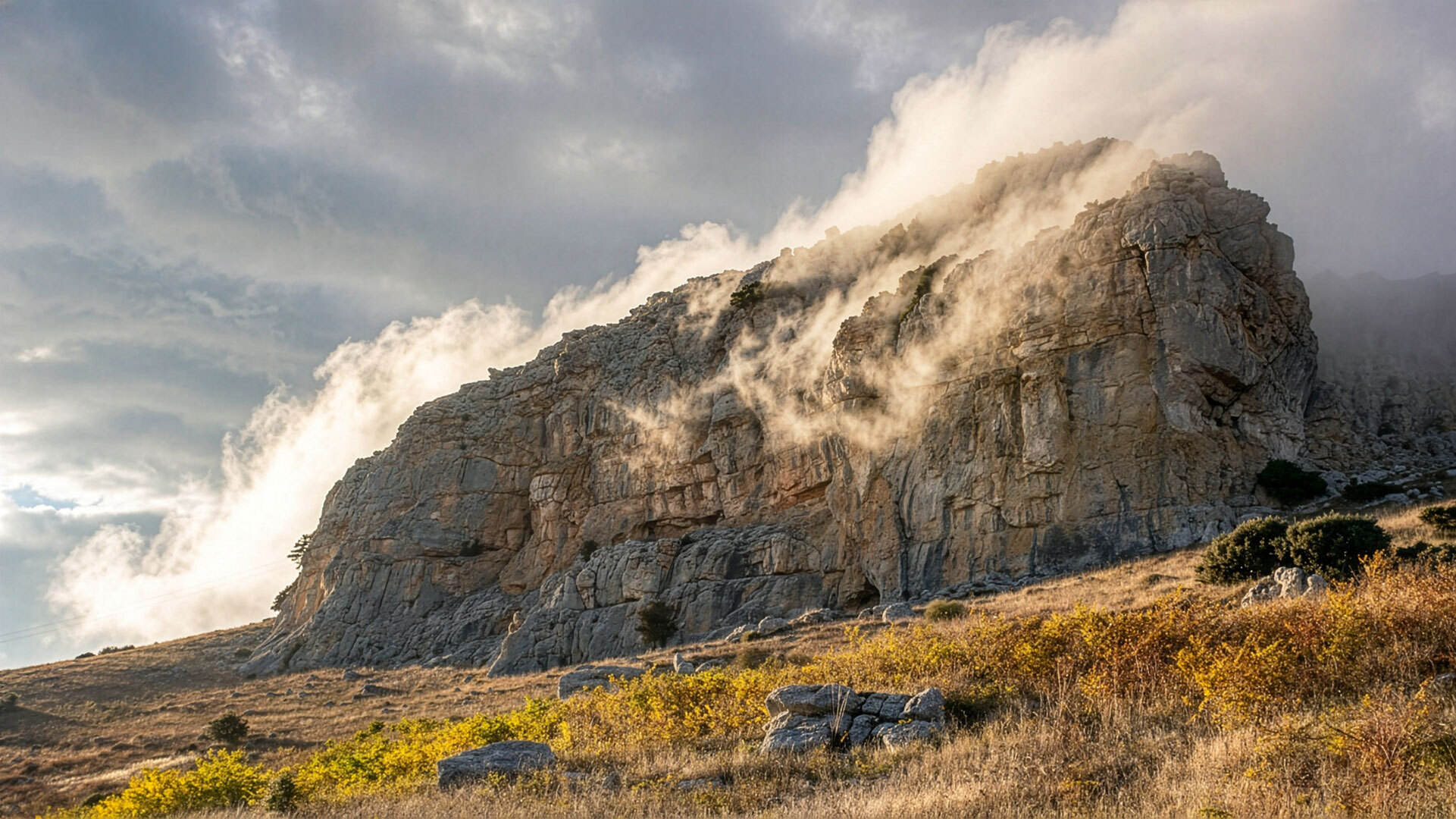
The Spanish word „Montera“ literally means „cap“ or „flat hat“. La Montera looks exactly like this: a solid, horizontal layer of cloud that appears to sit directly on the mountain peaks — as if someone had pulled a cap over the massif. The phenomenon occurs mainly in autumn and winter, when two very different air masses meet, and it is one of Antequera’s local hallmarks — known to anyone who has lived in the town for a few weeks.
How La Montera forms, why it is a reliable weather sign for locals, and what hikers need to watch out for — a step-by-step look at a local weather phenomenon.
The phenomenon: a mountain puts on its hat
La Montera is no ordinary mountain fog that appears diffusely and then dissolves. The phenomenon has a distinctive shape that sets it clearly apart from other cloud formations — which is what makes it unmistakable.
What the locals mean by it
Anyone in Antequera who looks out of the window before breakfast and sees the mountains to the south „smoking“ knows: La Montera is here. What looks like a thin line of white smoke or a flat, white disc is actually a dense layer of cloud sitting just above the ridge line of the karst. It looks as if it has been cut off sharply — no frayed edges, no wisps of cloud, just a solid blanket. Hence the name: a Montera, a hat, sits on the mountain.
For locals, this is not just a visual spectacle but a weather signal. When the Montera rolls in, it gets cooler, and often wetter too. In the Antequera valley, people often know the overall weather pattern is about to change before any forecast could have announced it.
When it happens most often
La Montera is seasonal — it occurs mainly in the cooler months, roughly from October to March. During this period, the temperature differences between the mild, damp Mediterranean climate to the south and the cooler continental air that gathers in the basin landscape of the Vega de Antequera are at their greatest. This very difference is the precondition for the phenomenon.
In high summer, La Montera is rare — the layering of air masses is different then, the temperature differences smaller, and the karst too warm. It returns with the first autumn storms, often several times a week.
The phenomenon is a classic example of microclimatic conditions — a weather pattern that does not play out on a large scale but within a narrow corridor between the Mediterranean coast and the basin hinterland. Three factors combine to create it.
Step 1: Warm air from the Mediterranean
From the south, from the coast of Málaga, warm, damp Mediterranean air pushes inland towards the north. The thermal difference between the sea and the hinterland regularly generates these currents. In autumn and winter, the sea air is still relatively warm — the Mediterranean cools more slowly than the land — and saturated with moisture.
Step 2: Cold air in the Vega de Antequera
On the other side, in the basin of the Vega de Antequera north of the karst mountains, cool continental air collects. Basin locations like this form genuine pools of cold air during the cold months: the heavy cold air cannot drain away and builds up. Temperatures here can be markedly lower than at higher altitudes.
Step 3: The barrier effect at the karst
Between the Mediterranean and the Vega lies the karst range of El Torcal — with altitudes of between 1,100 and 1,400 metres, a massive barrier running across the main direction of airflow. When the warm, damp sea air meets this wall, it is forced to rise abruptly. As it rises, it cools by around one degree for every hundred metres of altitude. The moisture condenses suddenly, and a dense layer of cloud forms — exactly where warm sea air meets cold continental air. This cloud then hangs as a flat, sharply defined layer over the peaks of El Torcal. The Montera.
What La Montera looks like — from below and from above
What sets La Montera apart from „ordinary“ fog is the contrasting effect it has depending on where you are. From the valley, it is an atmospheric spectacle; up in the mountains, a wall of cotton wool.
From the town: the mountain „smokes“
Seen from Antequera’s town centre, for instance from the Alcazaba, La Montera makes it look as though the El Torcal mountains are smoking. A flat white disc floats over the peaks, sharply defined at the bottom with clear sky above. In the low afternoon sun the cloud turns golden yellow; in the morning light, silvery white. Photographers love the hour after sunrise — the sun sits so low then that the Montera appears almost three-dimensional.
Up on the mountain: fairy-tale fog and visibility
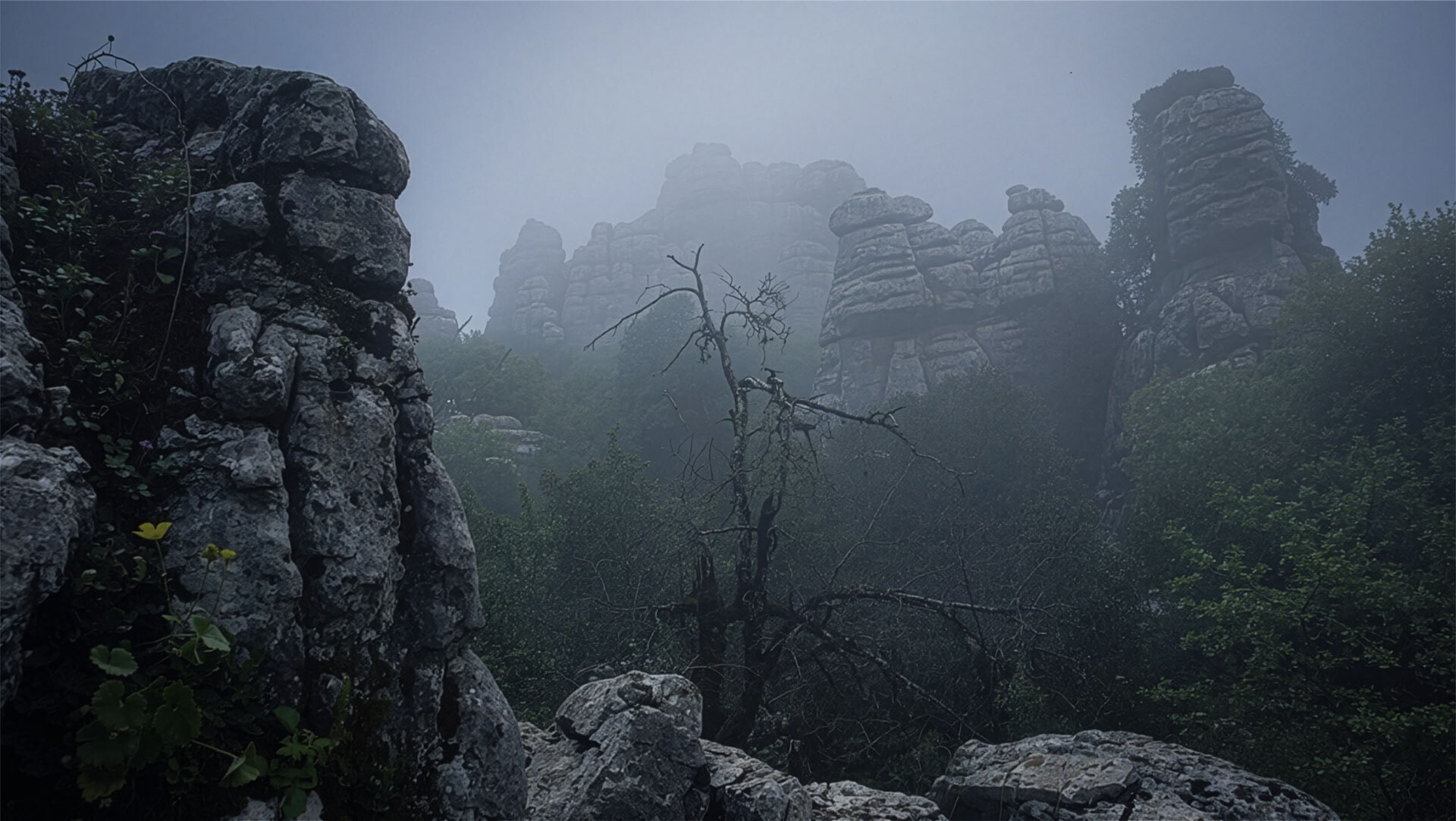
Anyone standing up on El Torcal at the same time, meanwhile, steps into another world. The white disc becomes dense, ghostly fog that catches in the crevices of the rock. The bizarre limestone formations then look like a surreal fairy-tale landscape, where you only recognise a rock pillar once you are standing right in front of it. Visibility can drop to just a few metres, and sounds become muffled. The rock labyrinth — already a place where you can lose your bearings even in clear conditions — turns into an enclosed, eerily silent space.
A weather omen for locals
For the people of Antequera, La Montera is a reliable weather sign. If you see the cloud cap on the karst, a change in the weather is highly likely within the next twelve hours — usually rain, wind, or a sudden drop in temperature. This is not folklore but sound microclimatology: the conditions that produce La Montera are exactly the same ones that herald an approaching weather front.
La Montera in the language of the town
The fact that La Montera is more than just a weather phenomenon shows in how the word has found its way into old Spanish proverbial wisdom. Antequera has a saying of its own:
„De Antequera, ni mujer ni montera.” Frei übersetzt: „Aus Antequera nimm dir weder eine Frau noch eine Montera.” Der Spruch ist alt und wird heute natürlich mit viel Humor und Augenzwinkern verstanden. Die Einwohner von Antequera haben darauf ihre ganz eigenen Antworten. Ein beliebter Konterspruch lautet zum Beispiel: „De Antequera, la mujer buena y la montera verdadera“ (Aus Antequera, die gute Frau und die echte Montera).
Today: the weather idiom lives on
While the first half of the saying has rightly disappeared from everyday use today, the weather part lives on. When someone in Antequera says „está la montera puesta“ — the Montera has been put on — everyone knows what is meant. It is the idiomatic equivalent of „it’s clouding over“ or „we’ll need a jacket today“. A local linguistic anchor that preserves the microclimate in a single phrase.
| When to expect La Montera | |
|---|---|
| Main season | October to March. This is when La Montera appears most often — sometimes several times a week, frequently as a harbinger of an Atlantic front. |
| Best viewing from the valley | From the viewpoint at the Alcazaba or from the Plaza Coso Viejo. Best light: 30–60 minutes after sunrise or shortly before sunset. |
| In summer | Rather rare. When it does occur, it is usually after prolonged hot spells, when the Mediterranean is especially warm and a change in the weather is approaching. |
Tips for photographers and hikers
Make use of the golden hours: La Montera looks most impressive in the day’s first and last rays of sunshine. Midday light flattens the cloud structure — morning and evening light gives it depth.
Aus zwei Höhen fotografieren:
Einmal von unten (Stadtgebiet, Alcazaba) für den Hut-Eindruck, einmal von oberhalb der Wolkengrenze, falls man in die Berge fährt und sie durchbrechen kann. Beide Perspektiven ergeben sehr unterschiedliche Bilder.
Bei aufziehender Montera nicht in den Karst:
Wird aus dem Tal sichtbar, dass La Montera kommt, ist die obere Felslandschaft binnen Minuten in dichten Nebel gehüllt. Die Sichtweite kann auf wenige Meter sinken — Orientierung schnell verloren. Im Zweifel umkehren.
Wenn man schon oben ist:
Auf den markierten Wegen bleiben, GPS-Track auf dem Handy haben, jede Abweichung vermeiden. Das Felslabyrinth wird bei La Montera zur echten Falle für Unaufmerksame.
Conclusion – mountains with a language for weather
La Montera is not just weather. It is a piece of lived topography — visible proof that the karst range of El Torcal is not merely a geological curiosity but a climatic factor with a language of its own. Anyone who has seen the phenomenon from the Alcazaba understands why Antequera has stood on this spot since antiquity: this is where worlds collide.
More on the geomorphology of the massif: Geomorphology of El Torcal. On the climate in general: Climate and the best time to visit. On the atmosphere in the old town: Antequera by night. More on Antequera in the magazine.
Frequently Asked Questions
What does „Montera“ mean?
When is La Montera seen most often?
How does the fog phenomenon form?
Should I go hiking in El Torcal when La Montera is present?
This article is based on the on-the-ground knowledge of the Gequo editorial team – publishers of several hiking guidebooks and operators of Sunhikes.com. Updated: May 2026