Dolmen de Viera in Antequera: a megalithic tomb that points exactly at the morning sun
Anyone looking through the entrance of the Dolmen de Viera sees what mattered 5,000 years ago: a narrow, straight corridor that points precisely to where the sun rises over the horizon in the morning. This is no coincidence and no reconstructed effect, but a deliberate decision by Neolithic builders to link their tomb to the start of the day.
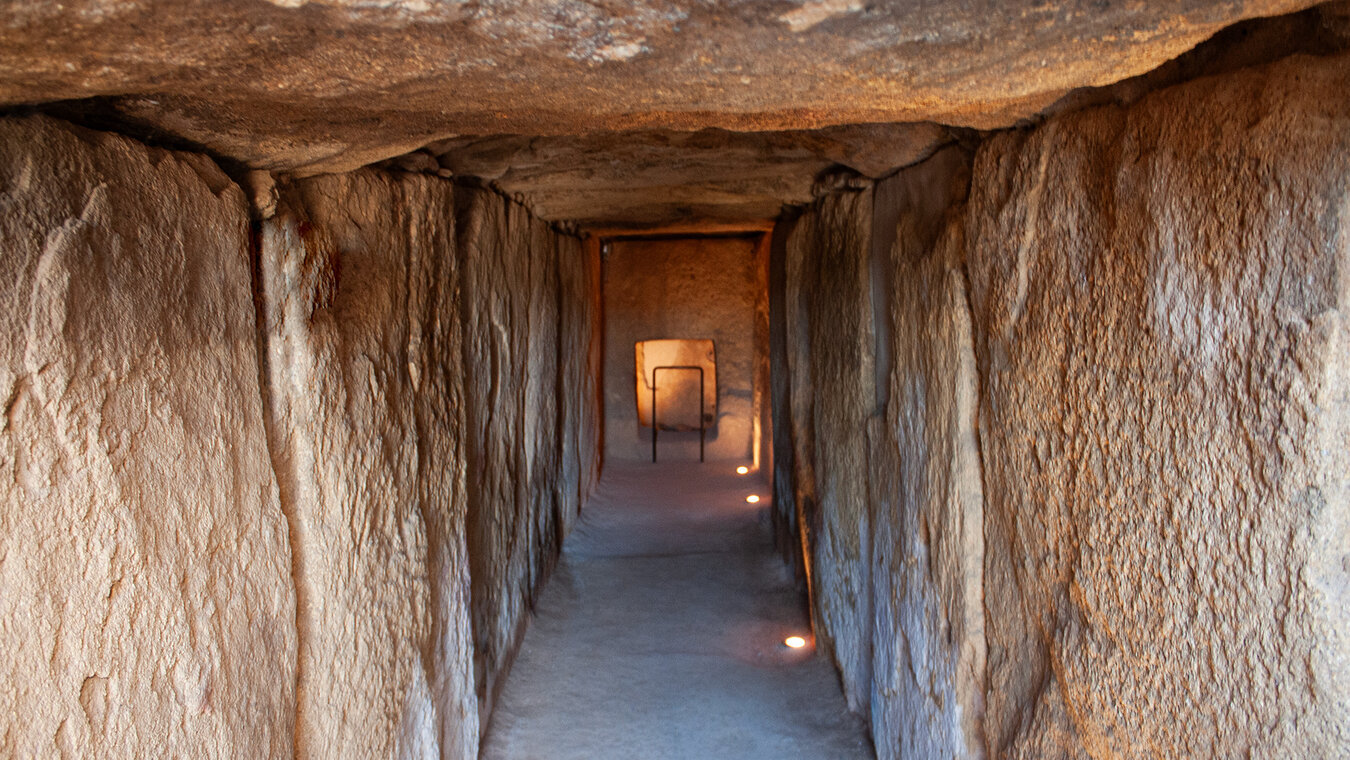
This passage is 21 metres long. Sixteen upright stones flank it, and at its end a small square chamber opens up – barely a man’s height, barely three paces wide. It is a structure that fascinates precisely because of its austerity: everything aligned on one line, everything focused on a single point on the horizon.
Der Dolmen liegt direkt neben seinem berühmteren großen Bruder, dem Dolmen de Menga, am Ostrand von Antequera. Beide gehören seit 2016 zum UNESCO-Welterbe „Sitio de los Dólmenes de Antequera”, zusammen mit dem Tholos de El Romeral, der Peña de los Enamorados und dem Karstmassiv El Torcal. Und doch erzählt jeder Stein hier eine andere Geschichte als sein Nachbar.
Fact file – the essentials at a glance
Dimensions, dating, location
The Dolmen de Viera is the second of the three great Antequera dolmens. Built at roughly the same time as Menga, but smaller, straighter and oriented in a completely different compass direction. Anyone visiting both in one morning grasps the contrast at once.
| Construction period | c. 3,500–3,000 BC (Neolithic, contemporary with Menga) |
| Length of passage | c. 21 m |
| Orthostats | 16 upright stones flank the passage (3 are missing at the entrance) |
| Capstones | 5 preserved (originally more) |
| End chamber | small, square – accessible through a narrow opening in one stone |
| Orientation | 096° east – classically Iberian, towards the morning sun |
| Tumulus | Burial mound c. 50 m in diameter |
| Status | UNESCO World Heritage Site since 15 July 2016 (together with Menga, Romeral, El Torcal, Peña de los Enamorados) |
| Opening hours/admission | ⚠️ check turismo.antequera.es · museosdeandalucia.es before visiting (as of: May 2026) |
Construction: 21 metres of standing stones
How a megalithic tomb worked 5,000 years ago
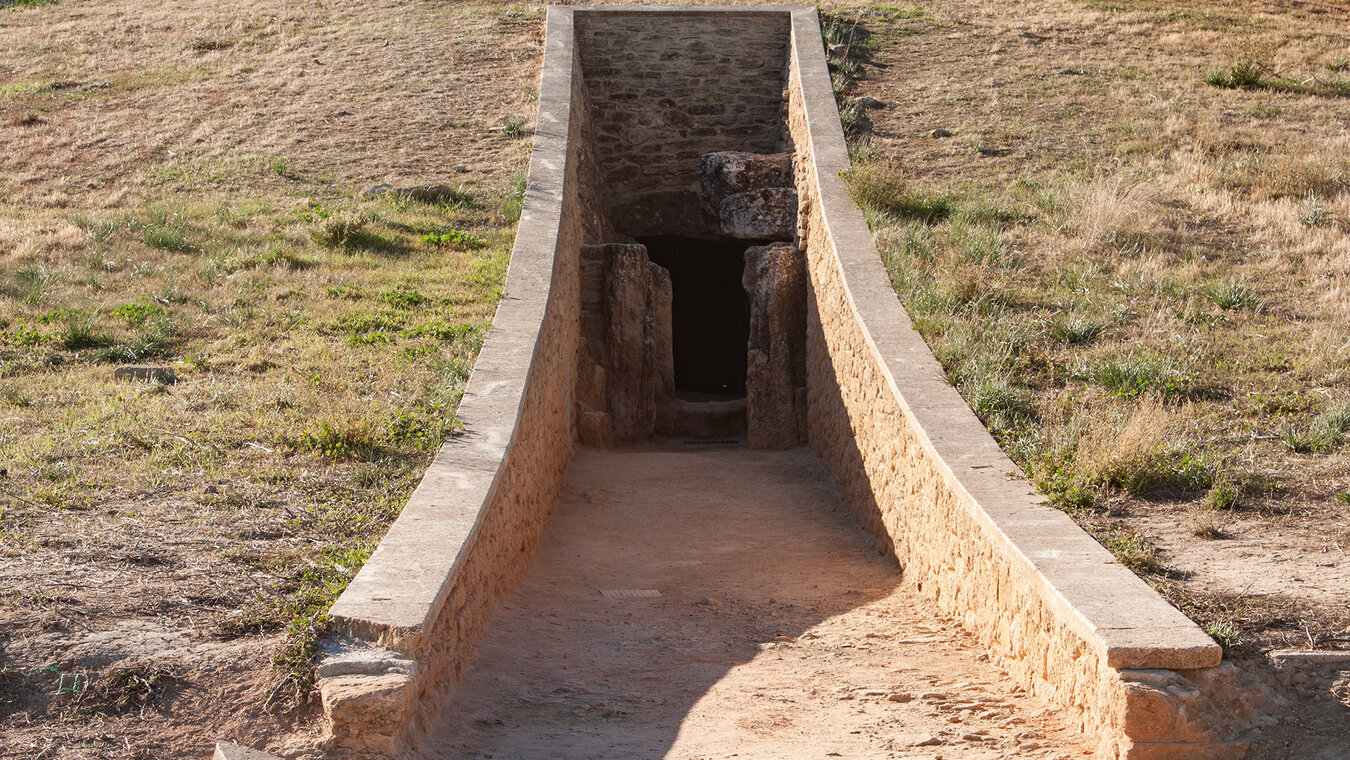
Der Dolmen von Viera ist ein klassisches Korridorgrab – ein langer, gerader Gang, an dessen Ende sich eine Kammer öffnet. Erbaut wurde er in Orthostatstechnik: große aufrecht stehende Platten (‘Orthostats’) tragen flache horizontale Decksteine. Es ist dieselbe Methode wie bei Menga, nur in deutlich schlankerer Ausführung.
Sixteen of these orthostats still stand today along the two walls of the passage, eight on each side. Three are missing at the entrance – lost over the centuries. Anyone entering the dolmen therefore walks the same line that was trodden in antiquity, narrowing towards a specific point.
At the end of the passage stands a single large stone with a narrow, almost rectangular opening. Beyond it, barely three metres square, lies the actual burial chamber. It is small – and that is deliberate: it was not the space that was sacred, but the way there. Anyone entering had to submit to the architecture.
Of the originally greater number of capstones, five survive today. A hole gapes in the rear capstone, presumably the work of grave robbers – when it appeared is unclear. Around it spreads a burial mound roughly 50 m in diameter, the tumulus that originally covered the dolmen completely.
The orientation: why 096° matters
Classically Iberian – yet with a touch of astronomy
The Dolmen de Viera is oriented at 096° to the east. This is almost exactly the line of the rising sun at the equinoxes, in late March and late September. On these two days of the year, the morning sun shines directly into the passage, passes through the narrow opening into the end chamber – and briefly lights up the interior.
Während der nahe Dolmen de Menga in 045° Nordost orientiert ist und auf eine natürliche Landmarke (die Peña de los Enamorados) zielt, gehört Viera zur klassisch iberischen Tradition: Megalithgräber auf der iberischen Halbinsel wurden ganz überwiegend nach Osten ausgerichtet, zur aufgehenden Sonne. Viera ist also der „normale” der drei Antequera-Dolmen – Menga und Tholos de El Romeral sind die astronomischen Sonderfälle.
Even so, the effect remains impressive. Anyone at the dolmen early enough in spring or autumn sees the axis of light move step by step through the passage. A precisely planned gesture – from an age in which astronomy and faith could not be separated.
Together with Menga and Romeral
Three dolmens, one World Heritage Site
What makes the Dolmen de Viera so special is not just its own construction, but its surroundings. It stands on the same site as Menga, the two only a few steps apart. The Tholos de El Romeral lies about two kilometres further east and dates from a later building phase – around 2,500 BC, roughly 500 years younger.
Since 2016, the three sites have been listed as a UNESCO World Heritage Site under the title Sitio de los Dólmenes de Antequera – the seventh World Heritage Site in Andalusia. What UNESCO explicitly honoured is the combination of three megalithic structures with two natural monuments: the Peña de los Enamorados and the El Torcal karst plateau. Menga is aligned with the Peña, Romeral with the El Torcal mountains, and Viera completes the ensemble with the classic solar orientation. Such a link between construction and natural backdrop for prehistoric astronomy is unique on the World Heritage List.
The dolmens were built by farming communities who lived in the fertile Guadalhorce valley between 5,000 and 2,200 BC. The nearest Neolithic settlement was Cerro de Marimacho, just 200 metres to the east. Other settlements lay in El Torcal and in the Sierra de Molina. Quarrying, transporting and raising stones of this size required several settlements to work together – evidence of a remarkably well-organised society, long before Europe’s first advanced civilisations.
UNESCO World Heritage Site: Sitio de los Dólmenes de Antequera
Eingeschrieben am 15. Juli 2016 als siebte Welterbestätte Andalusiens. Der Welterbe-Titel umfasst drei Megalithbauten (Menga, Viera, Tholos de El Romeral) und zwei natürliche Monumente (Peña de los Enamorados, El Torcal). Die UNESCO würdigt diese Kombination ausdrücklich als „einzigartig auf der Welterbe-Liste”.
Practicalities – when to go, what to bring
Best time of day, combinations, tips for getting there
To experience the Dolmen de Viera properly, come early: ideally shortly after the site opens, when the sun is still low and the light falls through the passage. The effect is strongest at the equinoxes in March and September – that’s when the morning sun really does shine all the way into the end chamber.
It makes sense to combine Viera with the neighbouring Dolmen de Menga in a single visit – both stand on the same site on the eastern edge of town, and admission traditionally covers both structures. Anyone wanting the full World Heritage day can add the Tholos de El Romeral: around two kilometres away, with its own history and a completely different construction method (a domed tomb rather than a passage grave).
The site lies directly on the A-7282 towards Granada, with its own visitor car park. Antequera town centre is about a 25-minute walk away, or five minutes by car. Combining a visit with a morning at El Torcal is easily done – the karst massif is only a 15-minute drive further south.
Tips for visiting the Dolmen de Viera
Best time of day: early morning after opening – low light streaming through the 21 m long passage
Special days: equinoxes in late March and late September – the sun shines all the way into the end chamber
Combination tip: Menga and Viera in one visit, followed by the Tholos de El Romeral (2 km east)
Admission: ⚠️ currently check turismo.antequera.es · museosdeandalucia.es (as of May 2026)
On site: visitor car park right at the site, Antequera centre 25 minutes on foot
Add-on: El Torcal is a 15-minute drive south – a good half-day plan
Conclusion: the quieter counterpart to Menga
The Dolmen de Viera is not the largest, not the heaviest, not the best known of the three Antequera dolmens. But perhaps the most concentrated.
A straight passage, a small chamber at the end, a line pointing exactly east – nothing more is needed to carry what mattered 5,000 years ago into the present. Anyone who has seen Menga will find in Viera the calm that its famous neighbour does not offer.
Continue to the Dolmen de Menga, the Tholos de El Romeral, the overview of the UNESCO World Heritage dolmen sites, and the El Torcal de Antequera karst massif. Back to the magazine overview
Frequently asked questions about the Dolmen de Viera
How old is the Dolmen de Viera?
What is special about its orientation?
Where is the Dolmen de Viera located?
Can Viera and Menga be visited together?
Why is Viera part of the UNESCO World Heritage Site?
This article is based on the on-the-ground knowledge of the Gequo editorial team – publishers of several Reisezeit hiking guides and operators of Sunhikes.com. Last updated: May 2026